Mentawai Daily Life & Subsistence
Daily Rhythm & Gender Roles
Shared Responsibilities, Different Expertise
Mentawai society is strongly egalitarian. Men and women hold different responsibilities, but neither role is valued above the other. Life unfolds through cooperation, with tasks shared or exchanged depending on age, skill, circumstance, and ritual needs.
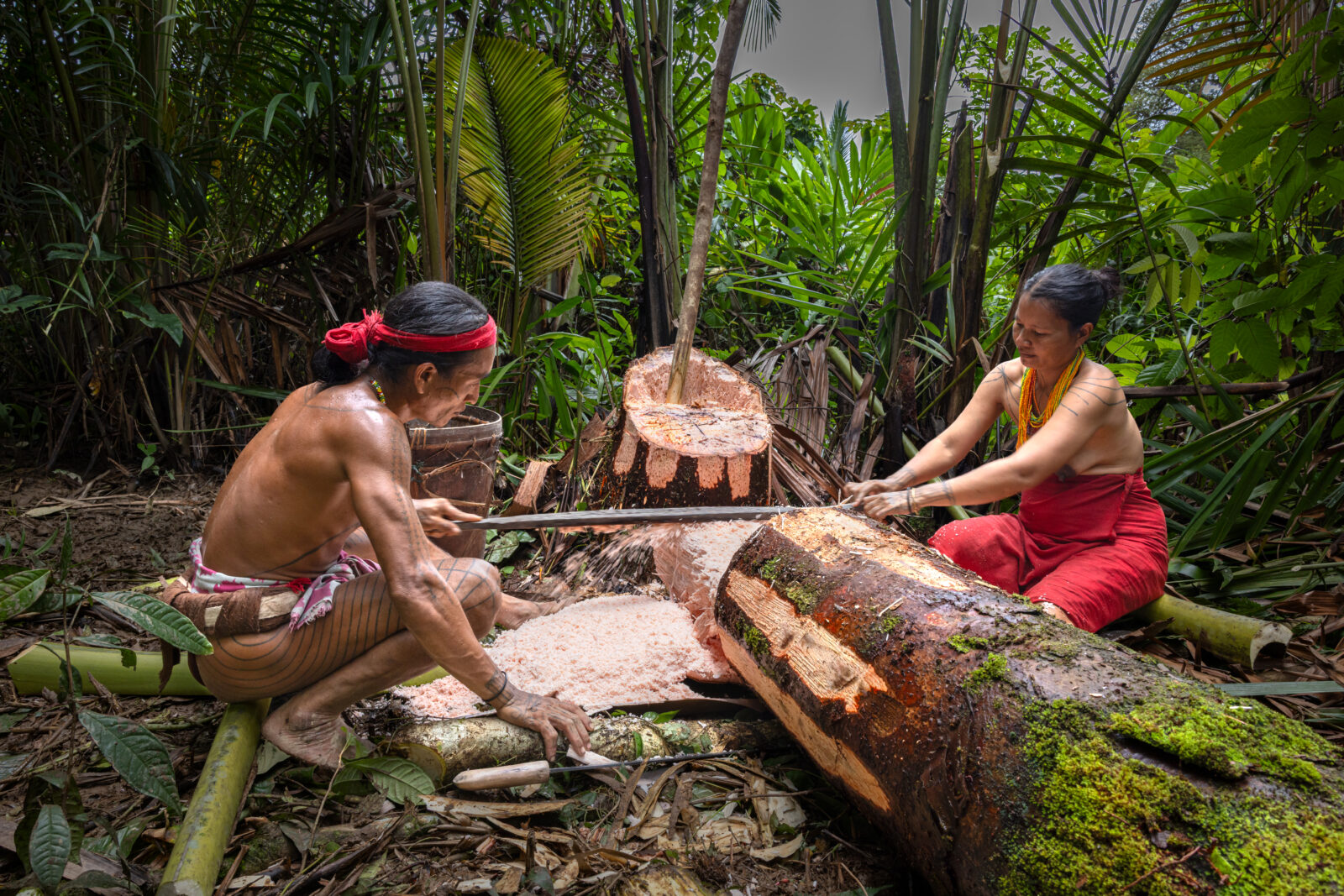
Men typically build uma, carve canoes, process sago trees, clear new gardens, hunt, and prepare rituals. Women tend gardens, prepare sago, make mats and baskets, raise young children, fish, and manage household tasks. But these roles are flexible; women may help with construction, processing sago, and men may prepare food or care for children.
Children learn through observation and participation. From an early age they accompany adults into gardens, forests, and rivers, absorbing knowledge through experience rather than formal instruction. Elders play a gentle but constant teaching role.
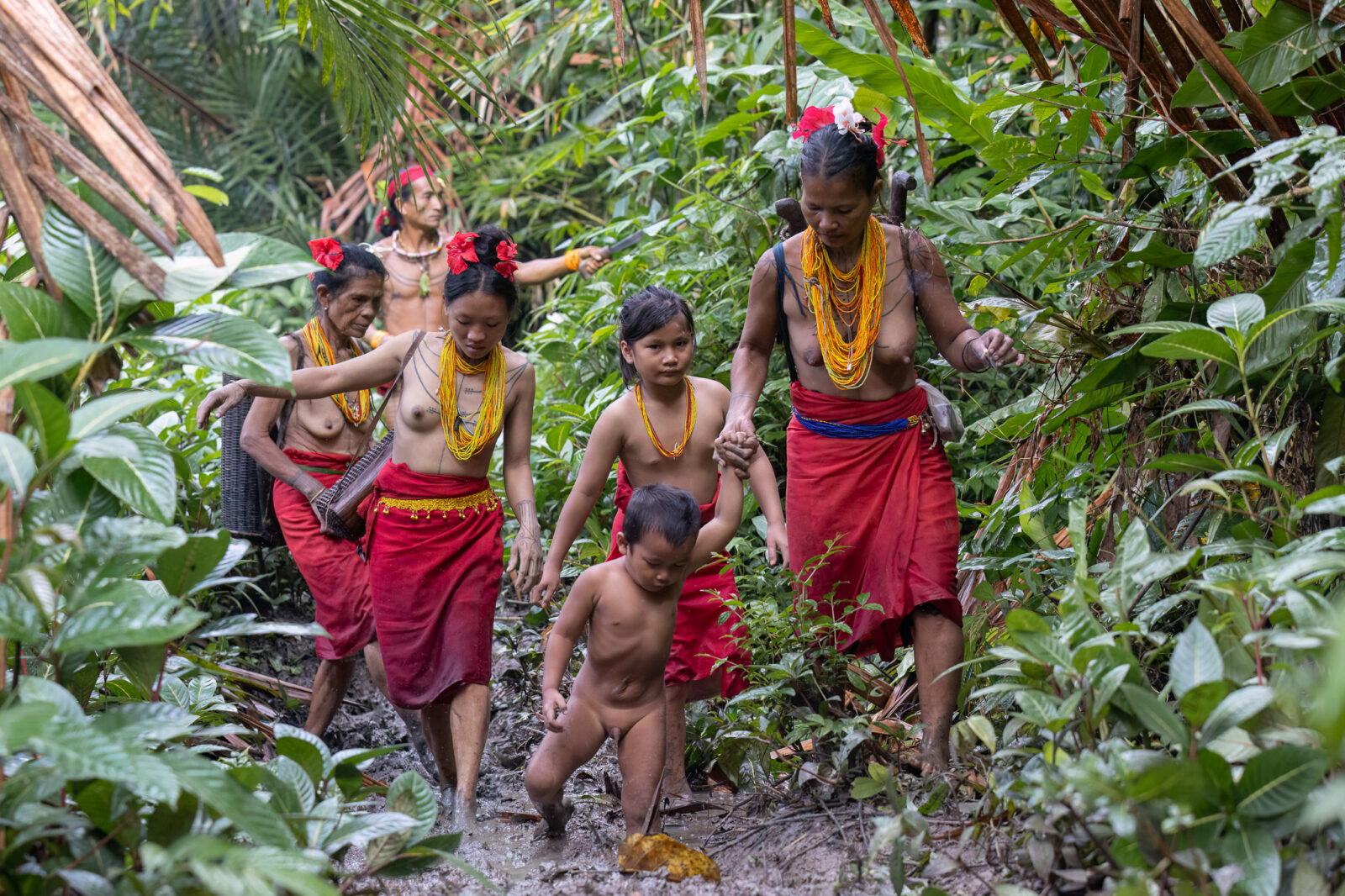
Daily life tends to be unhurried. The pace of activity follows environmental cues — rain, fruiting cycles, tides — and the need to maintain harmony with one’s soul. The expression moile, moile — “slowly, slowly” — captures not laziness but attentiveness; a reminder that rushing invites mistake, imbalance, or spiritual disturbance.
Evening hours are social. Stories are shared, tobacco is rolled, songs are sung, and the day’s activities are reflected upon. The uma is rarely silent: it is the living heartbeat of the clan.
Food & Subsistence
Living with the Forest — A Self-Sufficient World
Mentawai subsistence is rooted in an intimate, long-term relationship with the forests and river systems of Siberut. Their diet is diverse, seasonally flexible, and shaped not only by ecology but also by cultural values of balance, reciprocity, and respect for the souls of all beings.
Traditionally, the Mentawai do not struggle to support themselves. Food scarcity is rare: the forest, river, sea, and gardens provide everything a household needs. The island is sparsely populated, the soils fertile, and families are largely self-sufficient — growing crops, tending animals, and gathering or hunting from the surrounding environment.
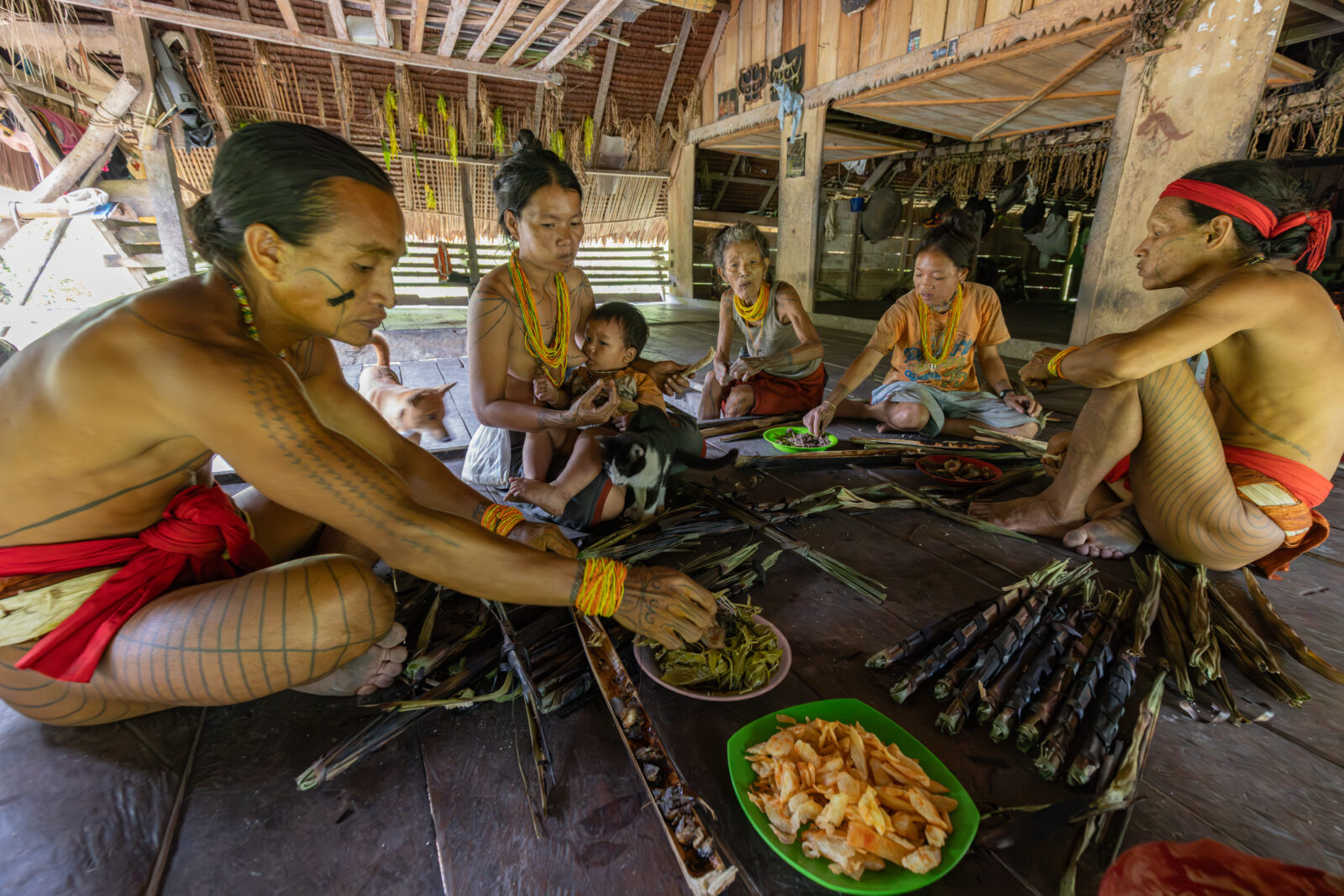
Sago, taro, and bananas form the core of the diet, supplemented by pigs and chickens, as well as wild animals caught in the forest, rivers, and occasionally the sea. The forest offers countless edible and useful plants, each known and used according to its season and purpose.
Work techniques are simple, efficient, and well adapted to the environment. Food production and preparation are straightforward and not excessively labor-intensive. There is no strict specialization: most people are skilled in a wide range of tasks, though some naturally excel in particular areas.
Work is divided by gender, largely according to differences in physical strength and daily responsibilities. Men take on tasks that require traveling farther from the uma — felling sago palms, clearing new gardens, hunting, constructing buildings, and carving canoes. Women focus more on activities in or near the house: tending gardens, preparing food, weaving baskets, making fishing nets, and caring for children.
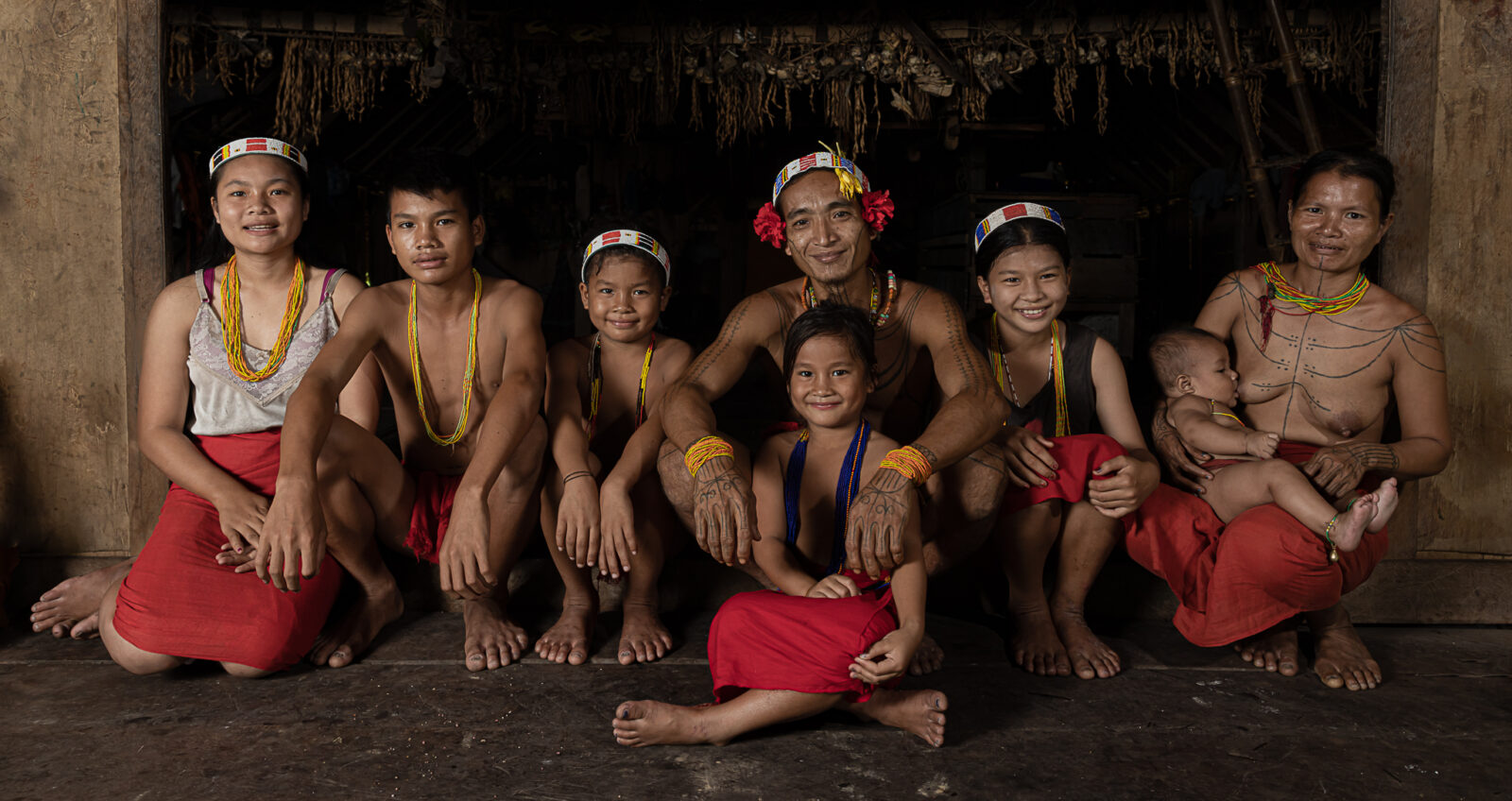
Children begin participating as soon as they are able. Sons follow their older brothers and fathers into the forest and gardens; daughters learn from their older sisters and mothers in and around the uma. Through shared work, they gradually acquire the skills needed for life in the forest — collectively producing everything necessary for a traditional Mentawai existence.
Sapou
Field Huts
The sapou is the Mentawai field hut — a small wooden shelter with bark walls and a thatched palm roof, built near taro gardens, sago groves, or favored fishing or hunting spots.
Unlike the communal uma, the sapou is modest and practical, raised on stilts to keep it dry and safe from animals. Its purpose is simple: to support the work that sustains daily life.
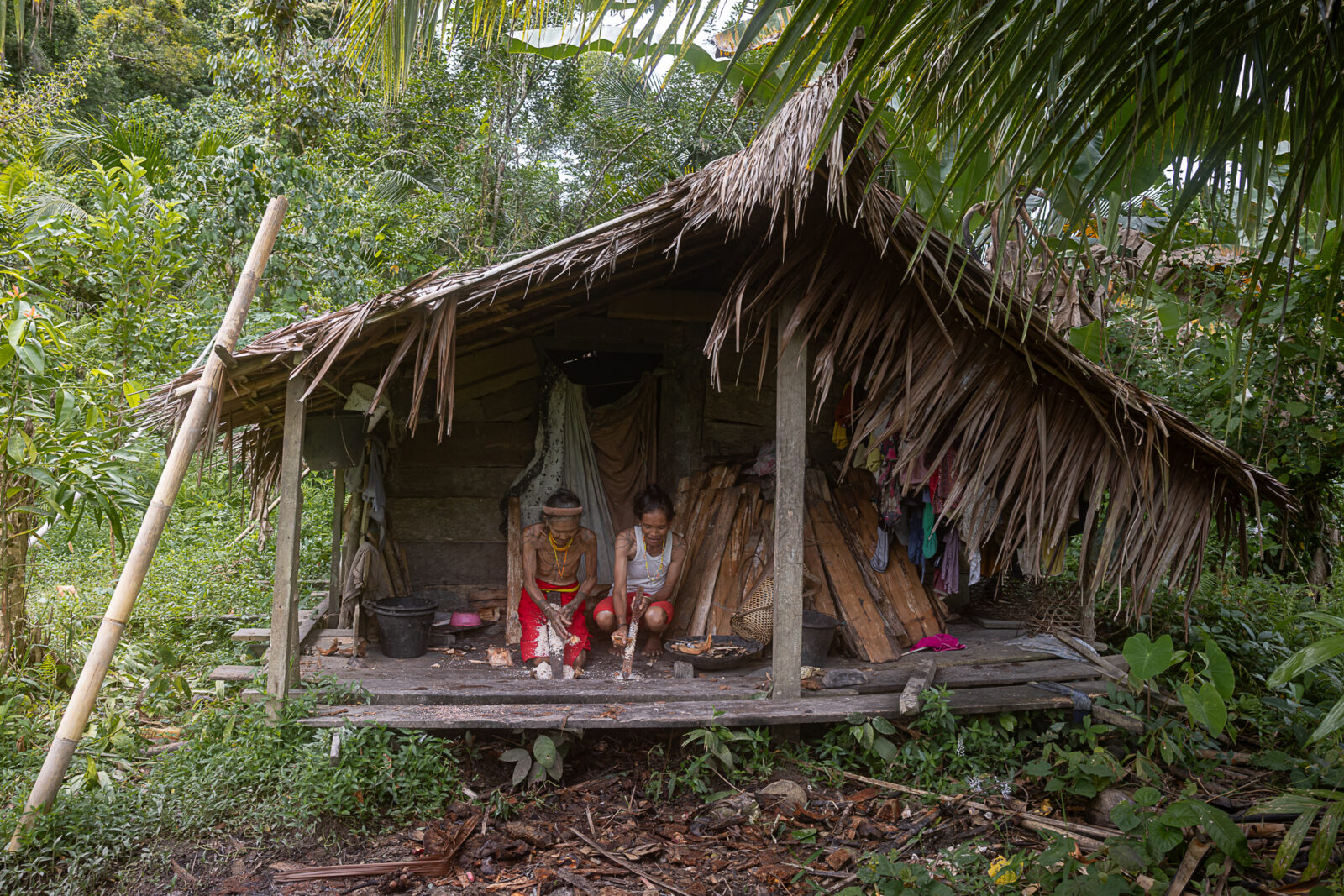
Some sapou are small and temporary; others evolve into more permanent farmsteads, especially when surrounded by productive gardens, or are used to raise chickens and pigs. These larger shelters, called rusuk, can remain in use for years, expanding slowly as families return to them season after season.
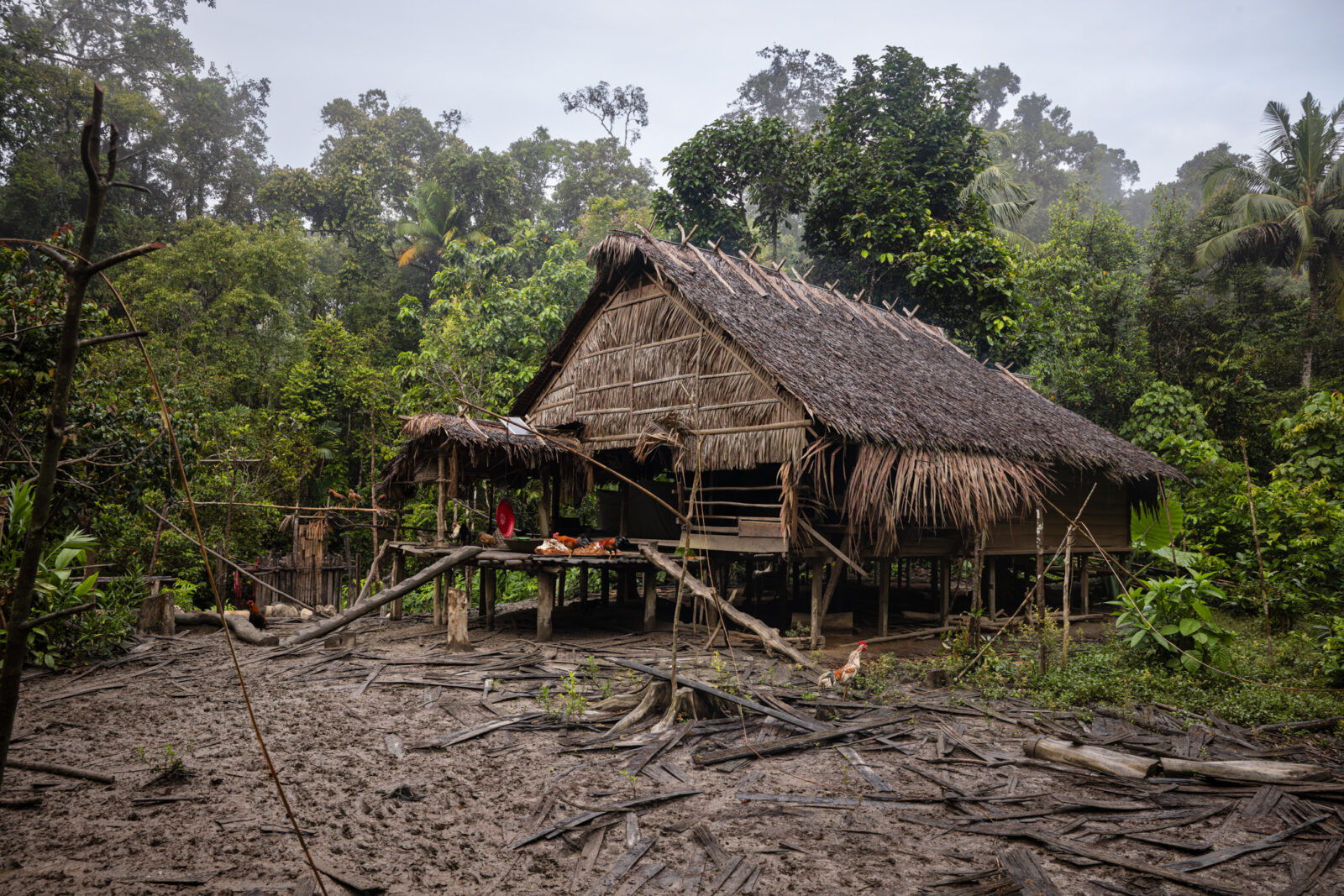
Families stay in a sapou for days or even weeks while tending gardens, setting traps, fishing, or processing sago. Inside, life is minimal: a single hearth, a rack for tools and utensils, baskets for storage, a place to sleep — everything shaped by the needs of forest work.
Yet the sapou is more than a workplace. It is also a space of warmth and intimacy. Children follow their parents through the routines of tending gardens or processing sago, absorbing skills through observation. Couples find privacy here, away from the communal rhythms of the uma. Nights around the hearth become moments of stories, quiet companionship, and rest.
Practical, secluded, and deeply tied to the land, the sapou reflects the Mentawai balance between labor, retreat, and family life — a refuge shaped entirely by the forest and the work it sustains.
Gardens and Forest Plants
Cultivating Abundance in the Rainforest
Upstream from Mentawai settlements, where rivers narrow and the land becomes more hilly and forested, families establish their agricultural fields and small plantations. Each household within an uma maintains its own plots in these areas, usually accompanied by a small field house, a sapou.
Shifting Gardens and Deep Plant Knowledge
Gardens form a vital part of daily subsistence. They provide bananas, taro, sweet potatoes, sugarcane, chilies, tobacco, and a wide variety of medicinal plants. Some plantations are located on higher ground, where drier soil supports different banana species, tapioca, turmeric, papaya, pineapple, and root crops suited to well-drained slopes.
Banana trees grow especially well on the dry banks of rivers and require little maintenance. Once established, a banana field can remain productive for many years as older trees continually produce new shoots.
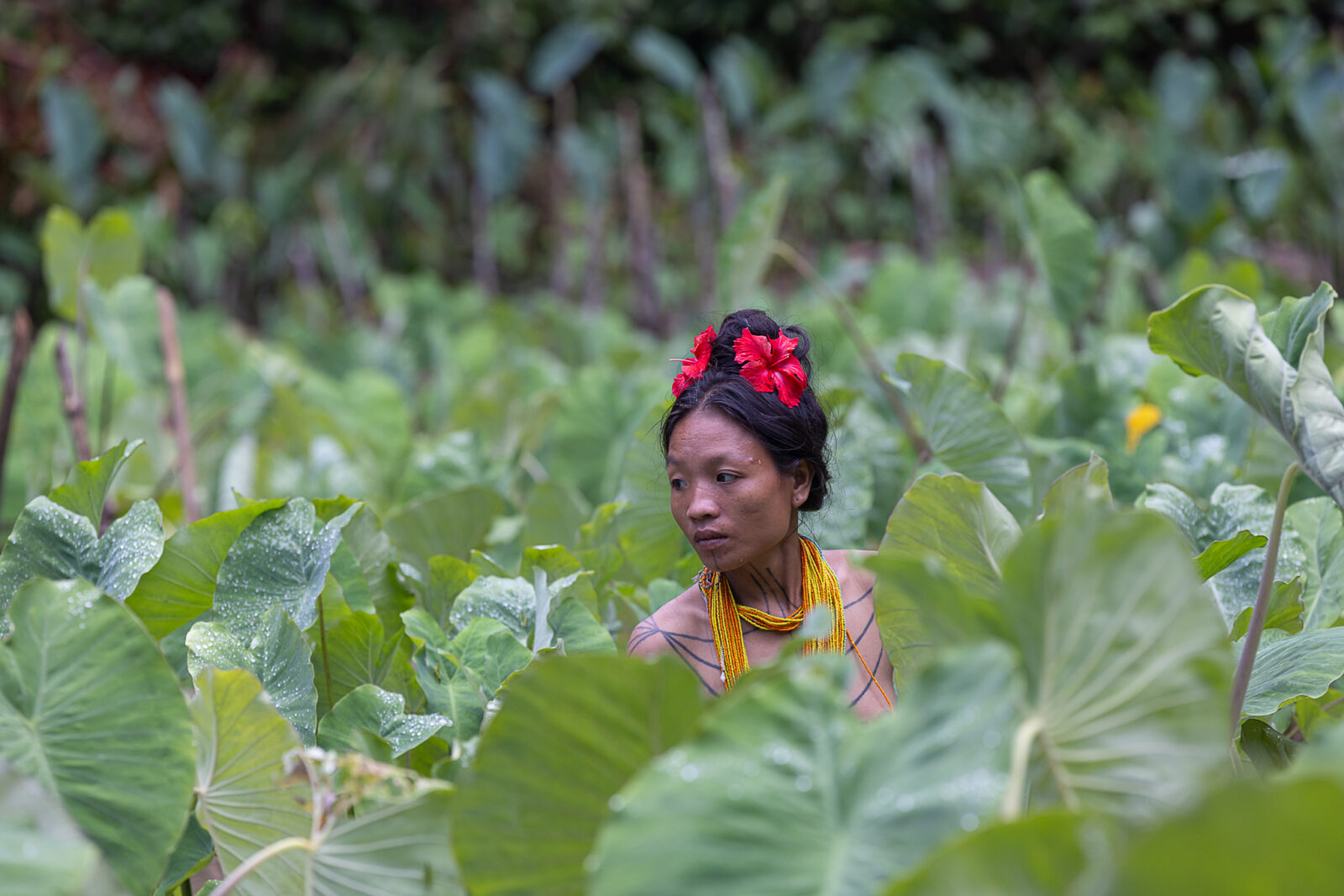
Mentawai agriculture is based on shifting cultivation guided by careful ecological understanding. New plots are prepared by a man and his wife together, usually not far from their sapou. They begin by clearing lower vegetation and small trees. Young banana trees and sweet potatoes are planted first among the remaining forest trees. Only after these crops take root are the larger trees felled.
Unlike many slash-and-burn systems in Asia, the Mentawai do not burn vegetation. Burning is considered wasteful. Instead, the felled branches and leaves are left to decompose naturally. Once the ground layer has decomposed, additional crops are planted — tapioca, papaya, chili, turmeric, lemon, medicinal plants, and occasionally pineapple or eggplant.
As banana plants grow tall and begin providing shade, families introduce seeds of slow-growing fruit trees such as durian, jackfruit, rambutan, mango, and others. Over time, fast-growing crops are harvested and replaced, while fruit trees mature gradually.
Eventually, when the soil becomes exhausted, the family allows the garden to rest. At this stage, only the fruit trees remain, transforming the old garden into a new kind of productive forest, called mone. For many years, families return to harvest seasonal fruits — sometimes long after the initial crops have disappeared.
Coconut Trees — One of the Most Valuable Forest Resources
Coconut palms grow along riverbanks, near sapou, and in old garden sites. Each tree has an owner, and theft was once among the most serious crimes on Siberut because coconuts were valuable for barter in the coastal villages and harbors.
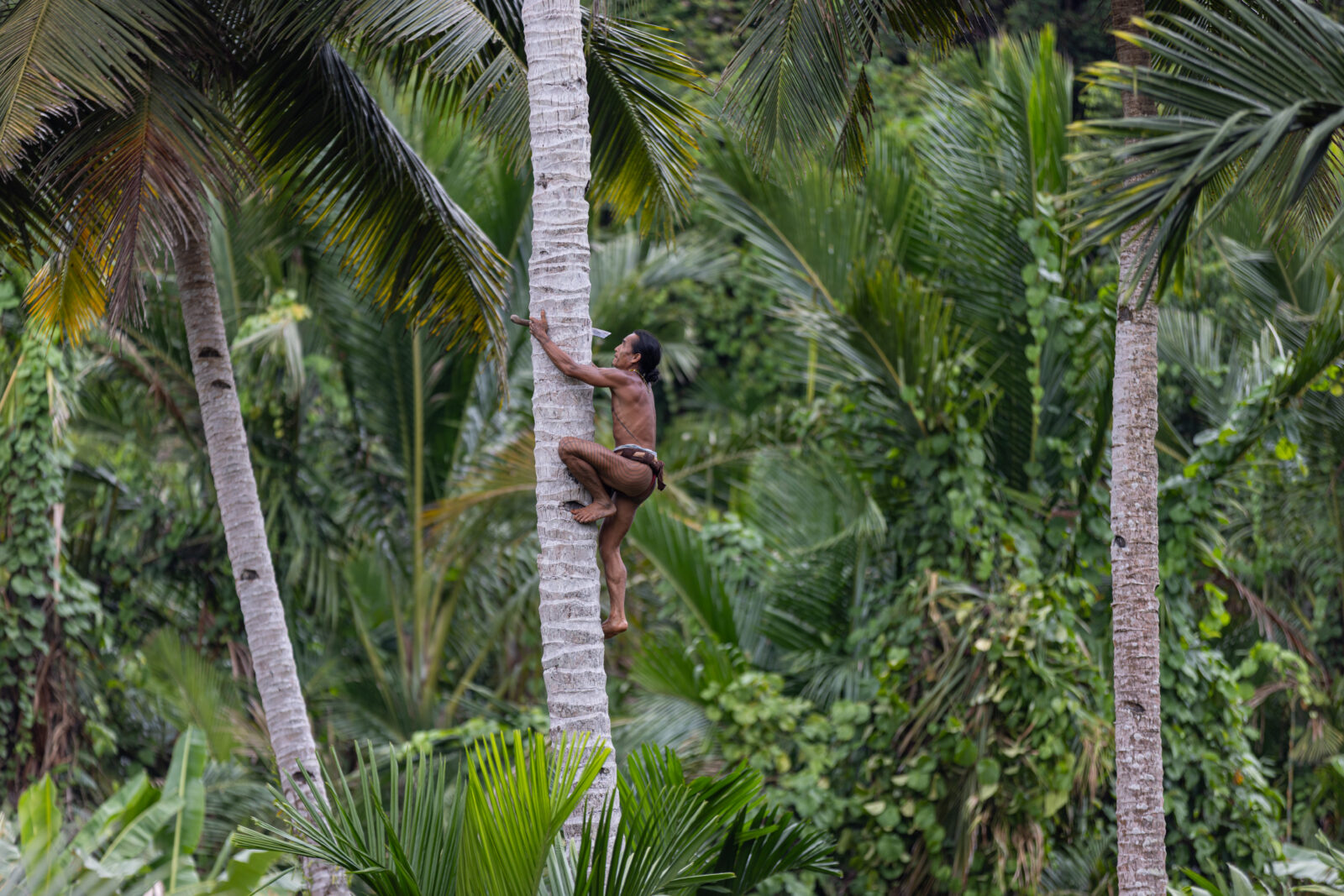
Coconuts are central to daily life. They provide food and drink, oil for cooking, fibre for rope, material for spoons, shells for containers and traditional tobacco boxes, and fronds for firewood.
Rope made from coconut husk is used for larger fishing nets and to carry the bugbug, the bamboo tube that men use for poisonous hunting arrows.
Gathering from the Rainforest
Beyond gardens and mone, the Mentawai maintain a deep connection to the surrounding forest. Inland areas contain nearly untouched rainforest, used sparingly but respectfully. Families gather rattan, firewood, trees for building houses and abak canoes, and a remarkable variety of edible and medicinal plants.
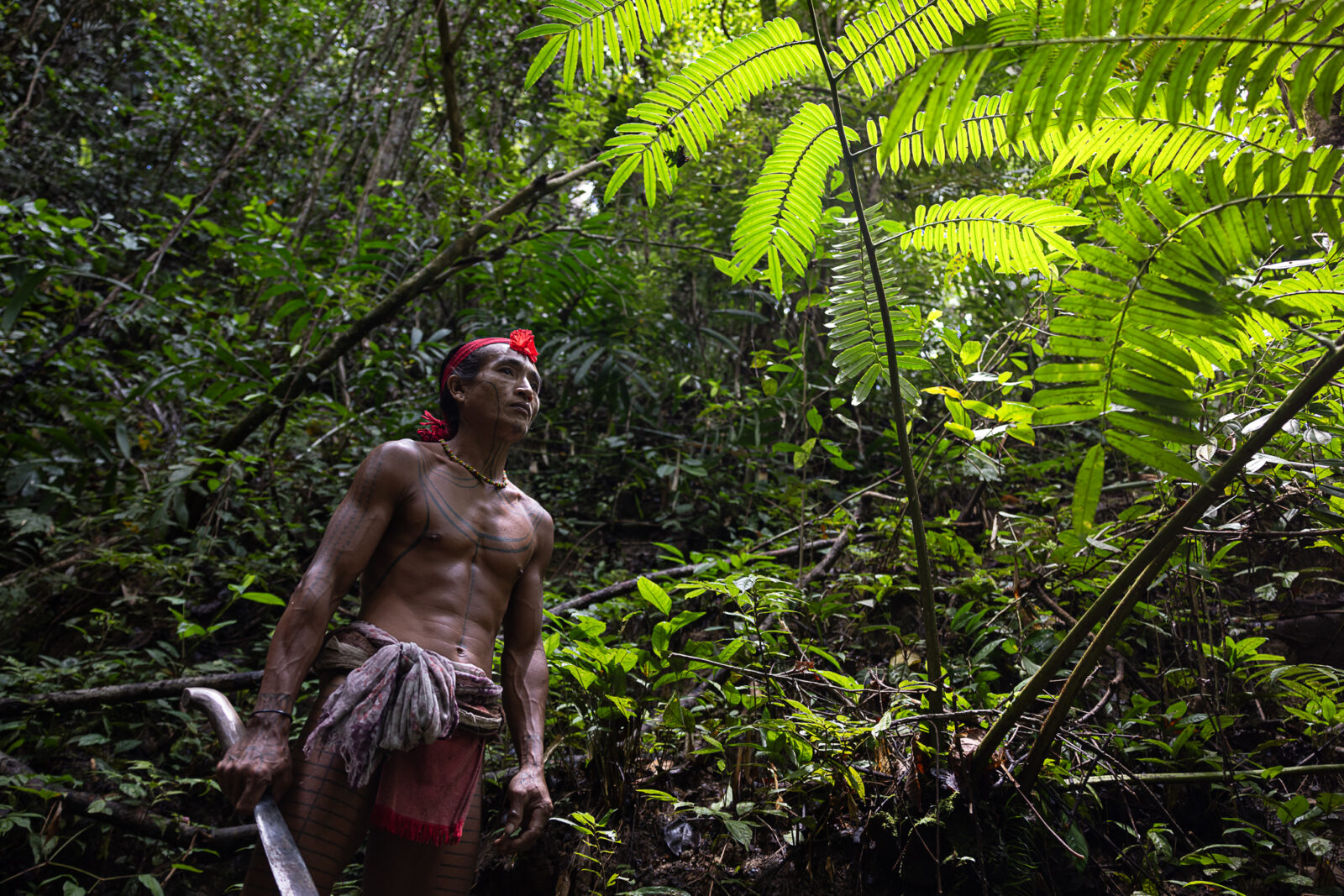
Wild foods include forest fruits, tender greens, young shoots, mushrooms, heart of palm, wild ginger, and seasonal delicacies that appear only at certain times of year.
Knowledge of the forest is extensive, built through generations of observation and practice. Children accompany their parents into the forest from a young age, learning which leaves can be eaten raw, which palms hold drinkable water, and which roots cure stomach aches.
Land Rights and Ecological Relationships
Although each household maintains its own plots, land use is shaped by clan rights, inherited claims, and ecological cues. Boundaries are understood collectively, planted and replanted across generations.
Gardens shift, forests regenerate, and productive forests grow in place of former fields.
This continual renewal — planting, harvesting, letting land rest, and returning years later — forms the foundation of Mentawai food security.
Agriculture and Foraging as One System
Together, gardens, productive forests, and the surrounding rainforest create a flexible, resilient food system. Cultivated plots provide regular staples, while the forest offers diversity and seasonal abundance. This blend of agriculture and foraging reflects a deep ecological literacy: a way of living shaped by close attention to soil, plants, seasons, and the vitality of the rainforest itself.
Sago
Tree of Life — The Foundation
Sago is the primary staple of the Mentawai diet — reliable, abundant, and central to daily life. The flour is made from the grated stem of mature sago palms, which grow in patches of swampy marshland called mata, literally “eyes”. Each mata has an owner: either the person who planted the first young palms or someone who inherited or received the patch as a gift.
A sago palm takes at least ten years to mature. The swamps where they grow are continually replenished by mineral-rich streams and seasonal flooding, making them exceptionally fertile. Because sago palms produce new shoots on their own, a well-maintained mata can sustain a family for decades. The cycle — planting, tending, harvesting — is part of a long-term relationship with the land and its spirits.
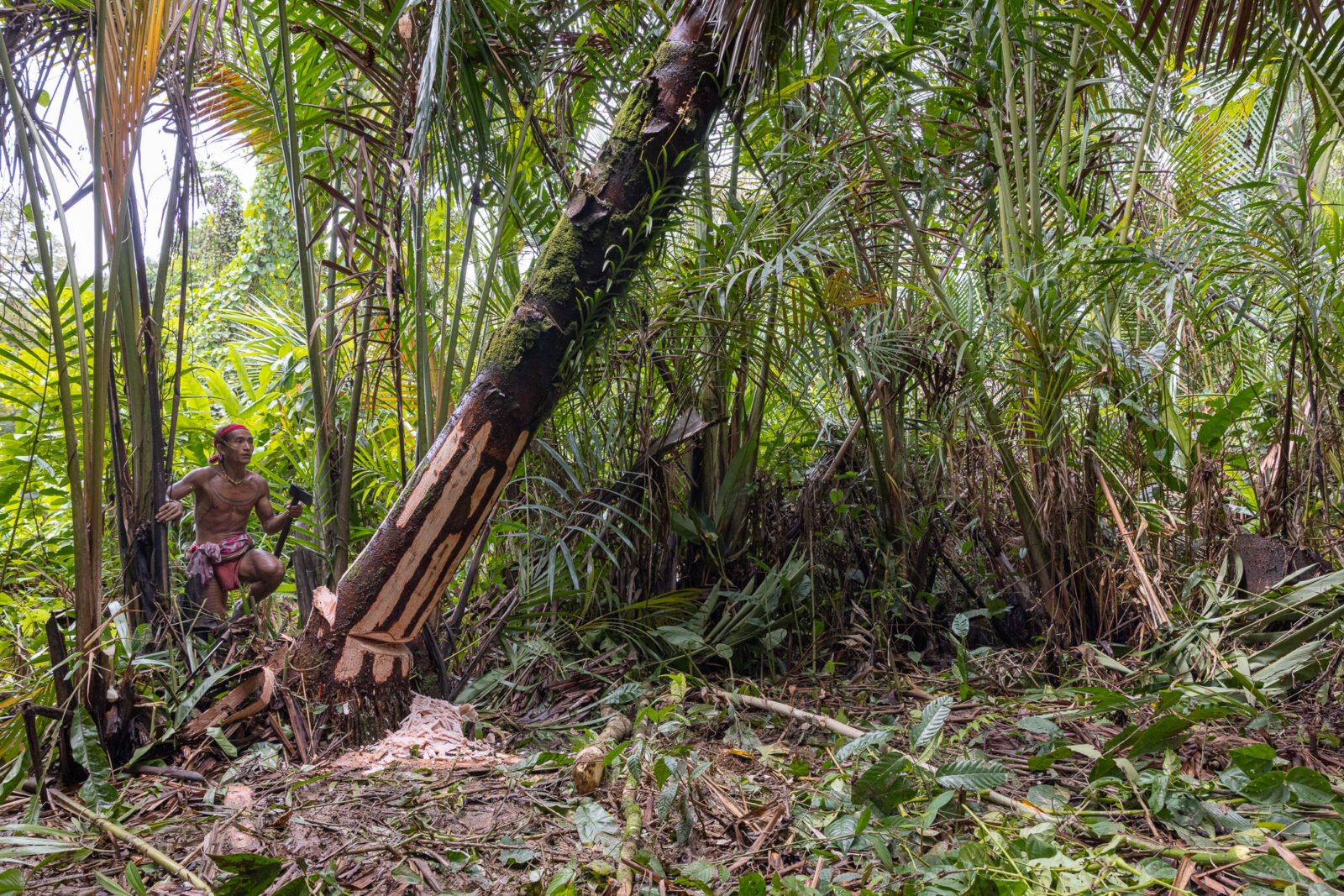
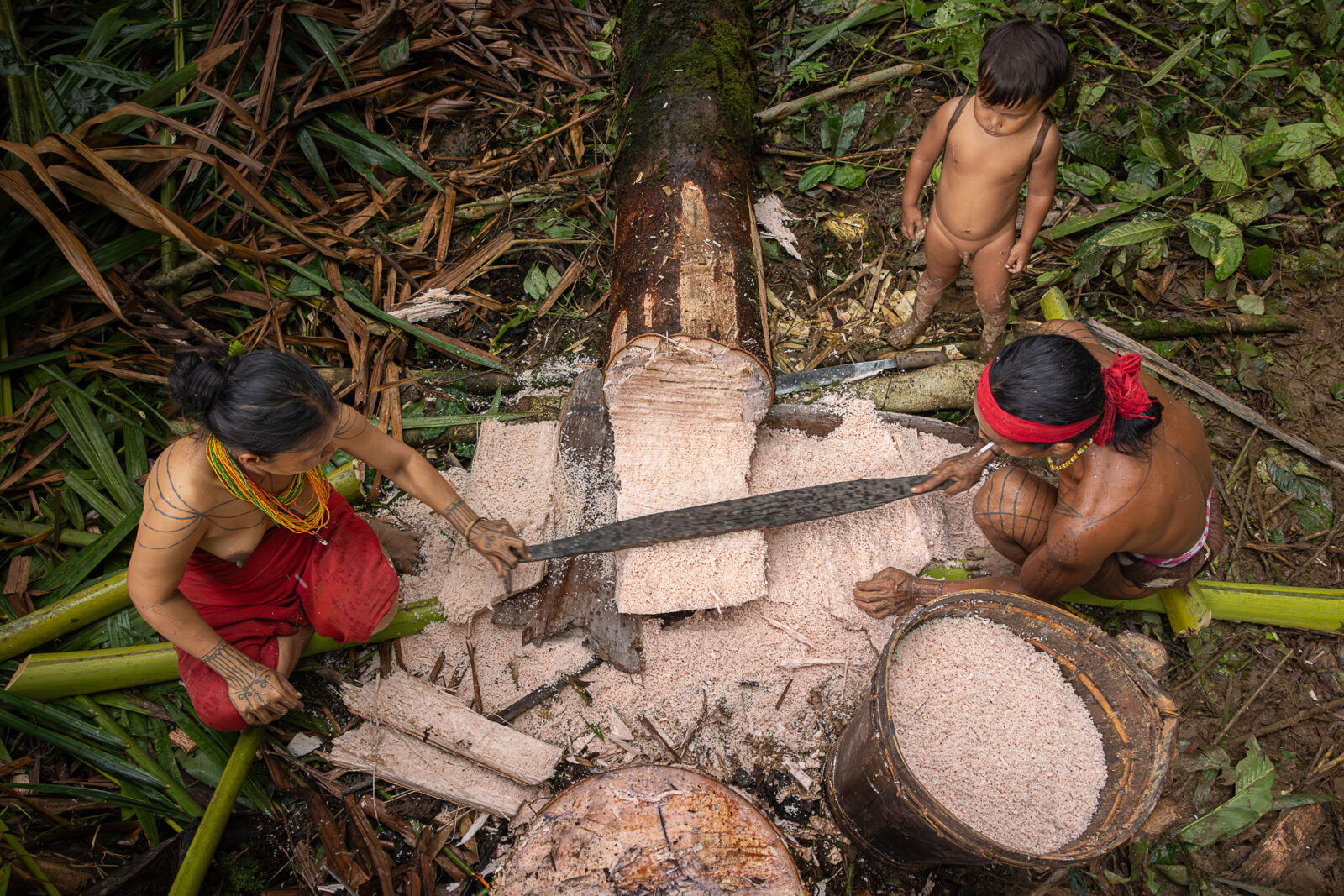
The work of harvesting and processing sago is primarily done by men and usually takes place deep in the swamp. Once a palm is selected, it is felled and its thick bark is split and peeled away using machetes and a heavy wooden adze. The soft, starch-rich core is then grated with a large wooden rasp studded with nails. The resulting coarse pulp is collected in large baskets and carried to a nearby creek.
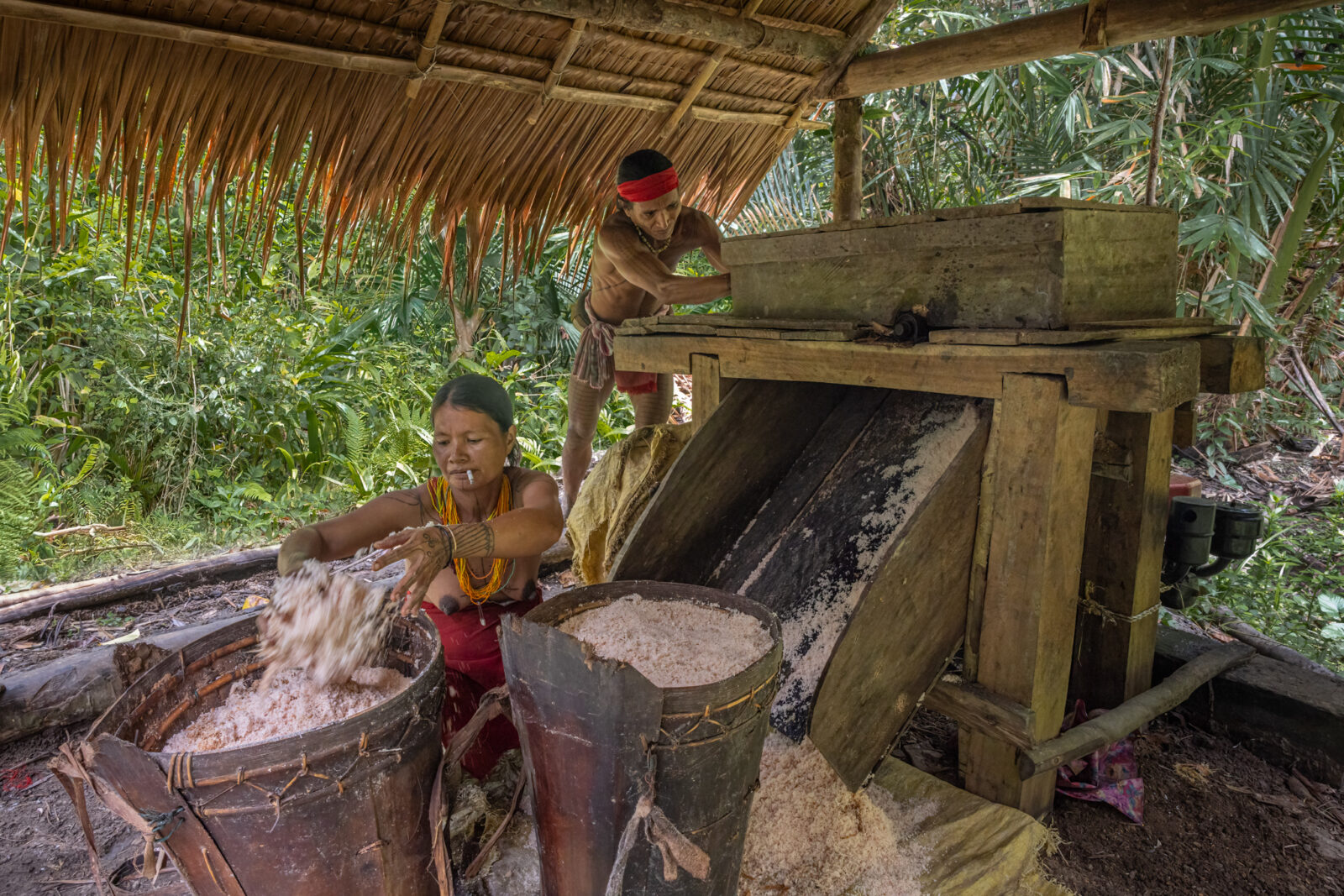
In recent years, mechanical sago graters have been introduced in some Mentawai communities. These machines, usually based on modified small engines, drive large grinding wheels that replace the slow and physically demanding process of manual grating. While not used everywhere, they have largely taken over this stage of sago processing where available, reducing labor time.
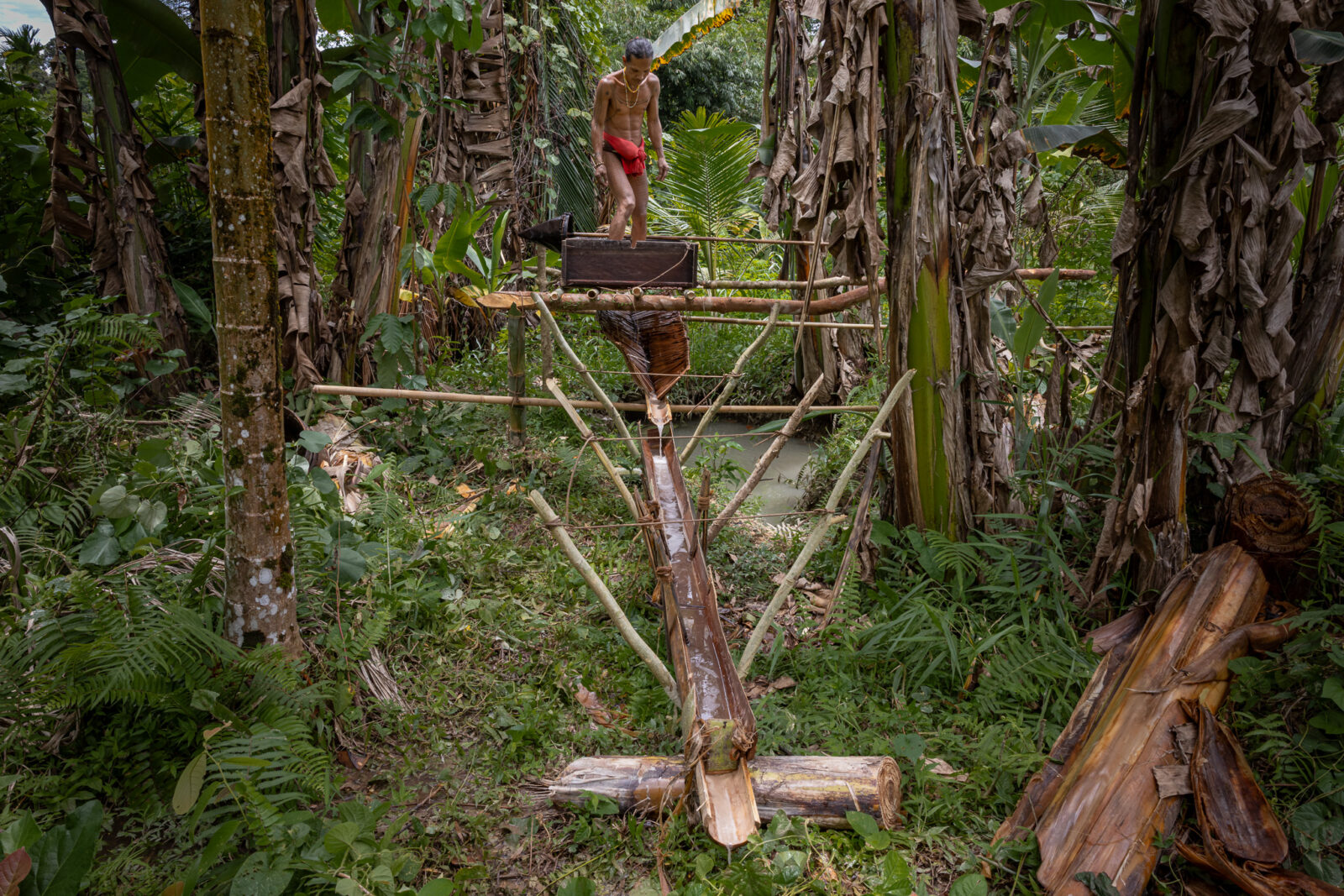
At the creek, the raw pulp is processed in a simple but ingenious setup known as the pasirereat — a small, one-person sago-flour factory. A large sieve made of bamboo and palm fibers is mounted on stilts above a shallow pool created in the stream. The pulp is poured into the sieve, where one of the men stands barefoot inside it. Using a self-made cone-shaped sink bucket attached to a long pole, he repeatedly scoops water from the pond and pours it over his thighs while rhythmically stamping through the pulp.
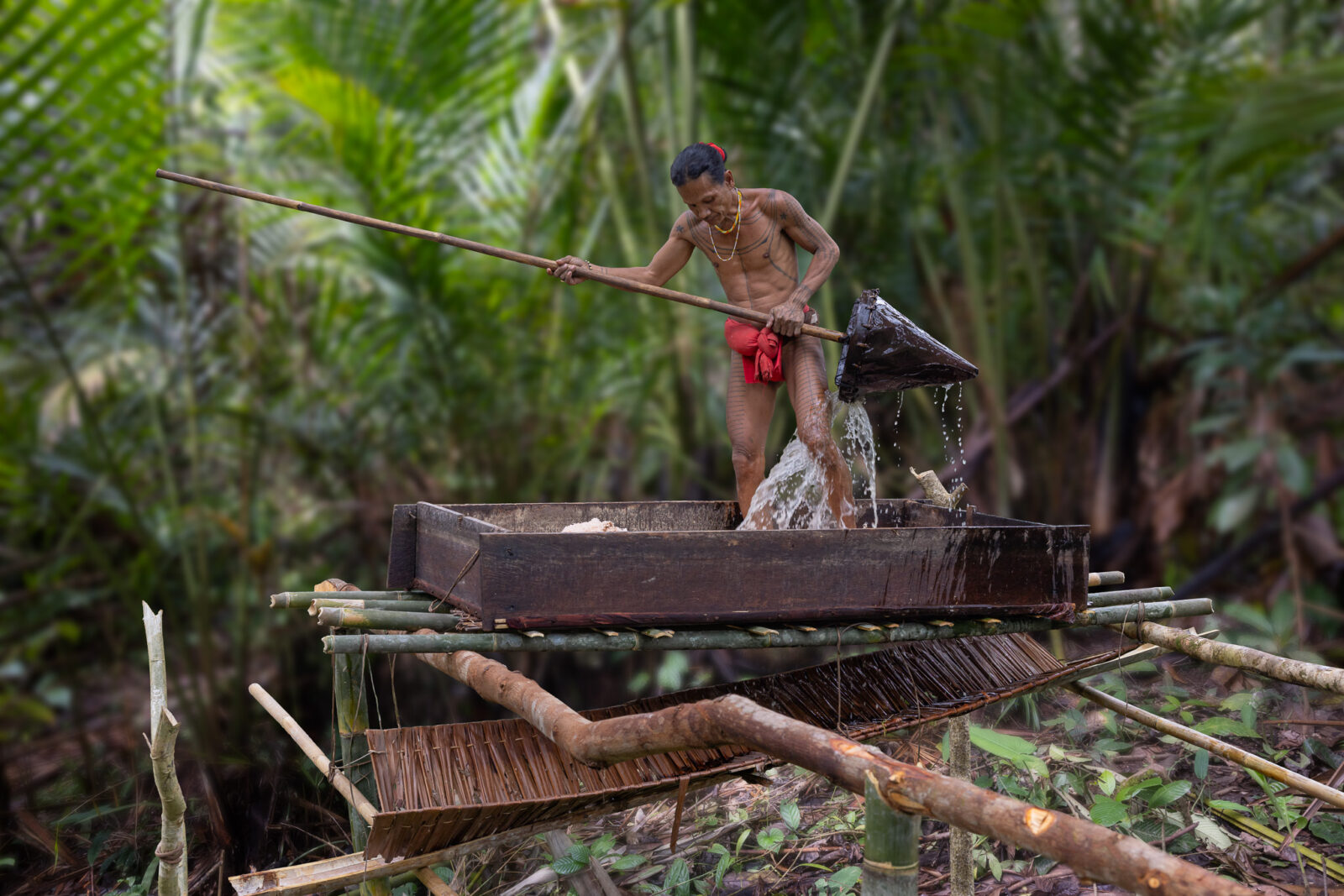
It is a unique sight — almost a dance — as water washes starch from fiber and sends the milky liquid flowing down into an old dugout canoe or extended bamboo trough below.
Inside the canoe, the fine sago flour slowly settles to the bottom while excess water drains away over the sides. After a few days, the thick paste is collected and packed into tall cylindrical containers made from sago leaf sheaths tied with rattan. These containers are stored underwater, where the flour keeps for months.
Sago is one of the world’s most time-efficient staple foods to process. A fully grown palm can yield up to 500 kilograms of dry flour — enough to feed an ordinary family for several months — and usually takes only a few days to complete. Several families often cooperate during harvest, sharing both the work and the resulting flour.
The sago palm is useful in many other ways. Its leaves are used to make atap roofing for the uma, and the leaf shafts are shaped into baskets and shaman suitcases, called bakulu. The palm is truly a tree of life, providing food, materials, and continuity across generations.
Sago Sticks
Wrapped in Leaves — Roasted in Fire
To prepare sago for eating, the fresh starch is shaped and cooked through a simple, ingenious method. The damp flour is pressed through a sieve, then sprinkled onto green sago leaves and tightly wrapped. These natural wrappers protect the flour from burning and hold it in a compact form.
The bundles are placed along the edge of the hearth, where they slow-roast as the outer leaves darken and char. Inside, the sago firms into a warm, chewy bar. Once unwrapped, it can be eaten plain, dipped in broth, or paired with roasted fish, pork, or forest greens.
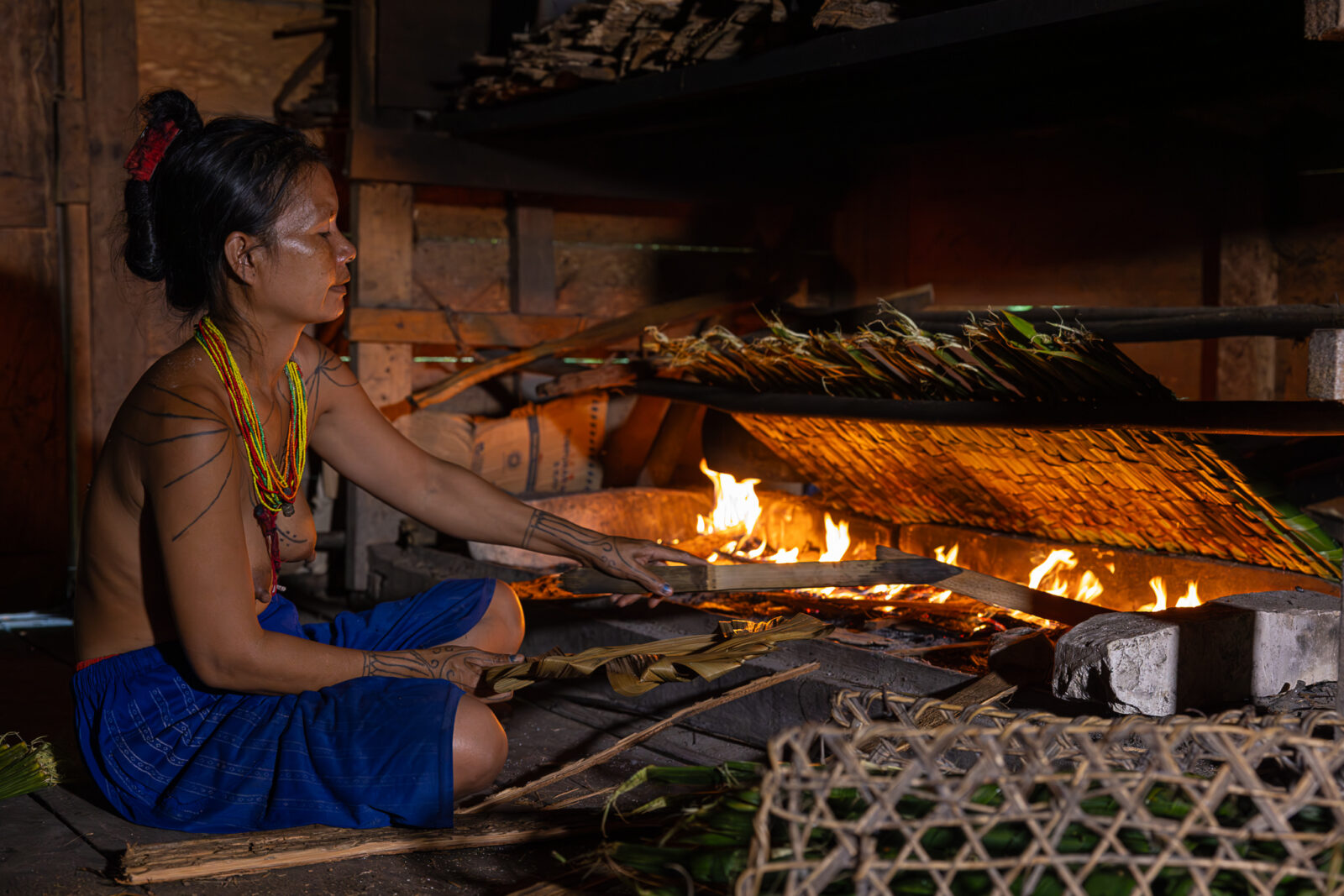
Practical, portable, and nourishing, sago sticks are the everyday form in which the “tree of life” sustains Mentawai families — from morning work in the gardens to long journeys through forest and river.
Sago palms provide far more than food. Their leaves are used for roofing, for making traditional hats, and for weaving temporary baskets to carry chickens and even pigs. The wide bases of the leaves are shaped and dried into firm, cardboard-like sheets, which are used to make baskets as well as bakulu, the traditional travel suitcases of shamans.
Taro
Roots of Life, Cultivated by Women
Taro is one of the central staples of Mentawai subsistence, providing a steady, nourishing source of carbohydrates throughout the year. Its starchy roots are grown in muddy, water-soaked fields near rivers and streams, often close to the uma or to a sapou (field hut). These gardens belong to the domain of women — taro cultivation is their knowledge, their responsibility, and a key expression of their role in sustaining the household.
Each woman tends her own taro plots, sometimes several at once. Through careful planting, weeding, and harvesting, she ensures food security for her family. Together, these patches form part of a larger mosaic of family gardens, maintained through shared labor and inherited ecological wisdom.
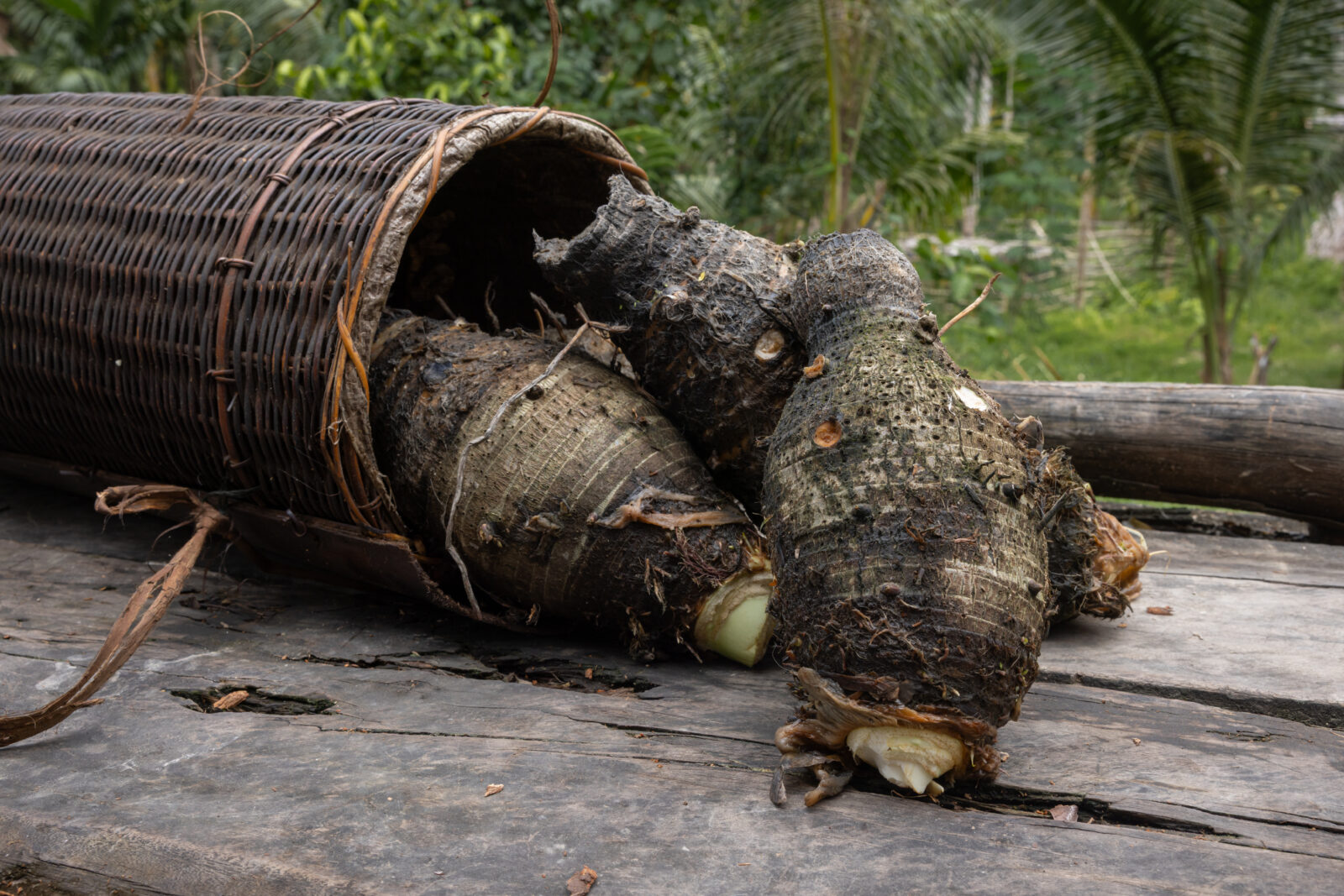
To protect the plants from wild pigs, the fields are enclosed with sturdy fences woven from branches and saplings. These natural barriers require regular upkeep, reinforcing the ongoing care that taro cultivation demands.
After each harvest, the soil is loosened and replanted. Taro fields can be used continuously for many years, renewed naturally by seasonal floods that deposit fresh minerals and organic matter. This rhythm of planting, tending, and renewal makes taro one of the most dependable cultivated foods in Mentawai life.
Nutritionally and culturally, taro complements sago. Together, these two staples form the foundation of daily meals, sustaining families whether they live along the rivers, near the coast, or deep in the forest.
Livestock - Pigs, Chickens & Pets
Animals of Food, Kinship, and Spirit
Pigs and chickens are the only animals traditionally raised by the Mentawai, yet their roles reach far beyond food alone. They are central to ceremony, social relations, and communication with the spirit world. Dogs and cats, introduced long ago through coastal exchanges, also live in the uma, each with its own place in daily life.
In recent decades, cows and water buffalo have been introduced with limited success, while ducks and geese — more recent additions — tend to adapt well.
Pigs
More than Meat
Pigs are the most valued animals in Mentawai society. They provide meat for feasts and ceremonies, serve as offerings during major rituals, anchor alliances between families, and function as a form of currency.
Unlike daily staples such as sago or taro, pork is rarely eaten casually. It is reserved for occasions of significance — marriages, house initiations, healing rituals, and the welcoming of important guests.
Families raise pigs with care. Each morning and afternoon, pigs are fed sago near the uma or sapou. During the day they roam freely through gardens and nearby forest edges; at night they return to sleep beneath the raised floors of the uma or field shelters.
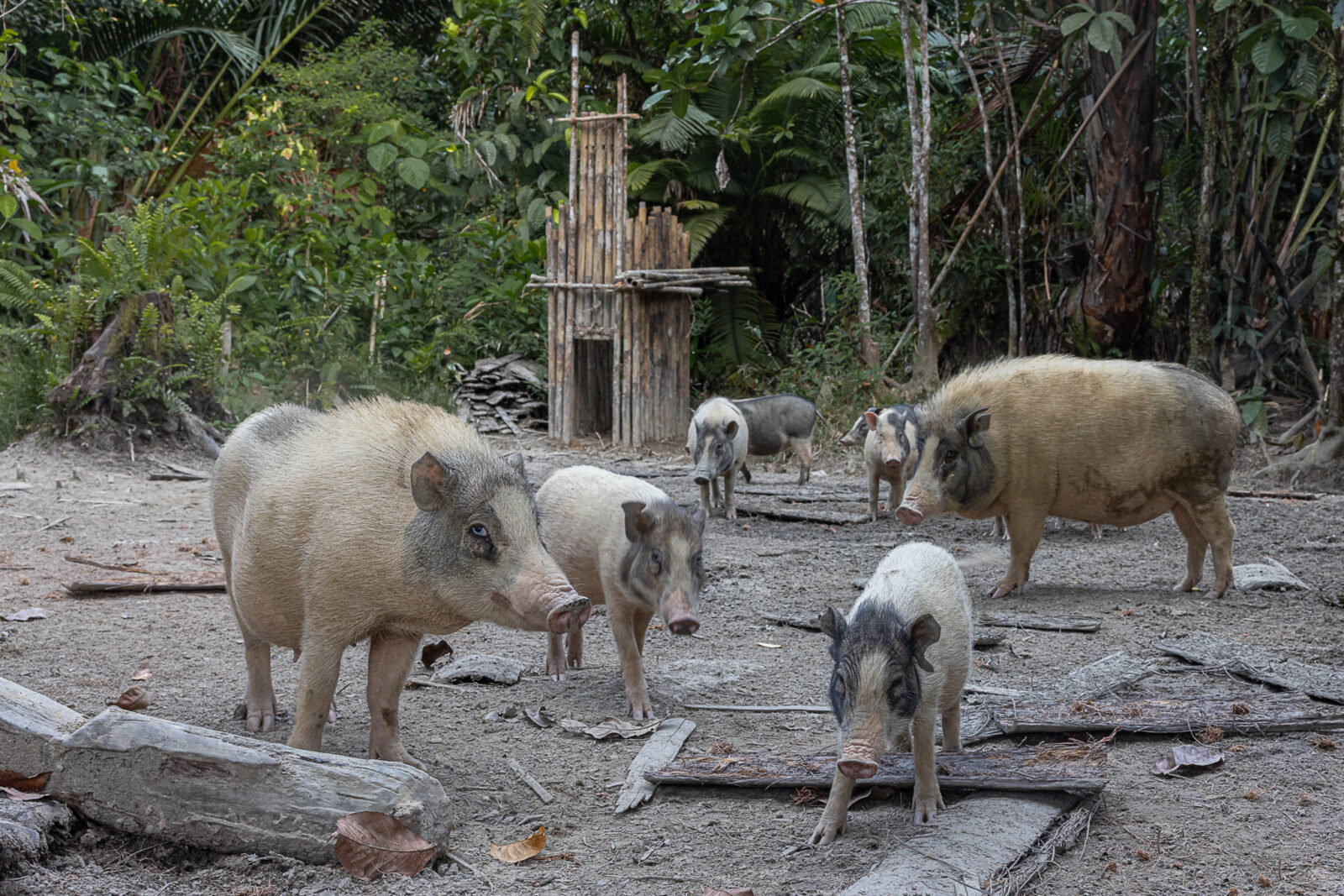
Birth and reproduction unfold without pens. Sows give birth in the forest, and piglets begin eating independently within a month. As female pigs become pregnant, they often chase boars away. When most sows are expecting, boars may wander far in search of mates, sometimes joining pigs from other uma or even wild herds.
To prevent this, families castrate the boars. Castrated males remain close to home, grow larger and fatter, and are valued for ceremonial use. Since young males reach maturity within a year, reproductive cycles continue without risk.
Pigs are surrounded by taboos. When a sow is visibly pregnant, the owners avoid planting crops, delousing, or having intercourse — actions believed to disturb the souls of the piglets or cause misfortune.
Pigs as Wealth, Prestige, and Currency
A family with many pigs commands respect. The more pigs an uma can provide for ceremonies, the higher its prestige within the valley.
When a pig is slaughtered, the meat is shared equally among relatives and neighboring uma, reinforcing bonds of kinship. Cooking is communal, often done in large cast-iron woks kept for such occasions.
Pigs also function as a means of negotiation and exchange. They form part of bride-price payments and return gifts during weddings and are offered in friendship agreements between clans. Pigs can be traded for goods or services, particularly items that were once available only through coastal trading posts, such as iron tools, glass beads, or cloth. Today, pigs are sometimes sold for cash, which has gradually taken over their role as the Mentawai’s primary medium of exchange.
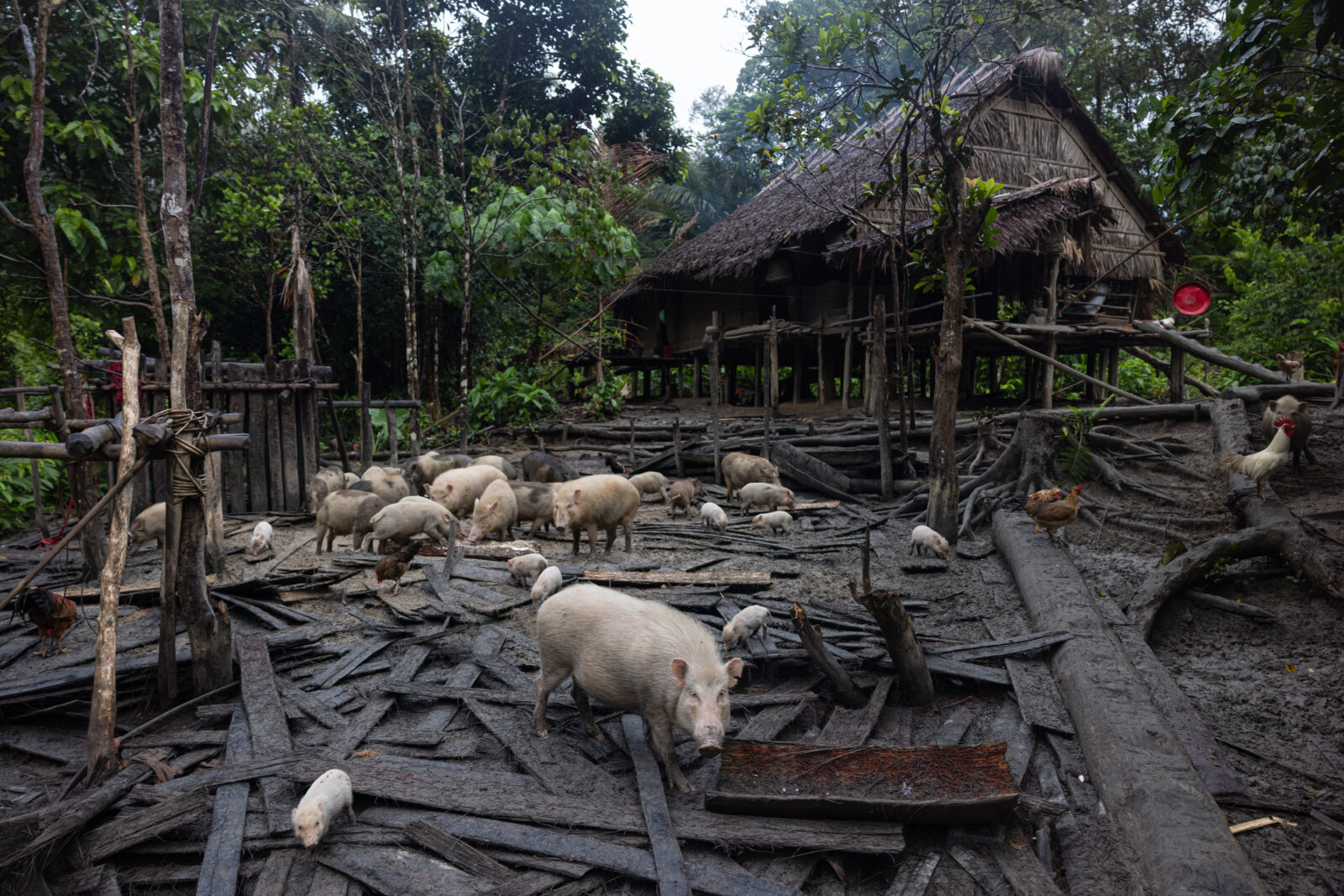
Pigs in Ritual Life
In ritual practice, pigs hold the highest value. Their souls serve as powerful gaut — mediators who carry messages to the unseen world. Before a sacrifice, the pig is spoken to, thanked, and “cooled” with blessings to ease its soul.
Afterward, the shaman reads the pig’s heart for signs of acceptance or warning from the spirit realm.
In this way, pigs feed bodies, strengthen kinship, and sustain spiritual relationships. They are among the most meaningful animals in Mentawai life.
Ritual Life Under Pressure
Over the past two decades, the Mentawai Islands have repeatedly been affected by outbreaks of African swine fever, severely reducing pig populations across the archipelago. This has placed significant constraints on ceremonial life, as major rituals require the sacrifice of many pigs. Where families once relied on their own livestock, they now often have to purchase pigs specifically for ritual use, further increasing the need for cash income. As a result of scarcity, pigs have become more valuable than ever. While some families have begun to rebuild their herds, others continue to face difficulties in meeting ceremonial needs that depend on the availability of pigs.
Chickens
Everyday Animals, Ritual Significance
Chickens are everywhere in Mentawai settlements. They roam freely by day, scratching for insects around the uma and forest edge. In the afternoon, chickens with chicks are placed in woven rattan baskets for the night and fed grated sago and coconut. They are moved regularly between sapou to ensure fresh foraging grounds and reduce the risk of predators.
Chickens are rarely kept for eggs alone; this is seen as wasteful. Every egg has the potential to produce a chicken, and many chickens can be raised from a single brood.
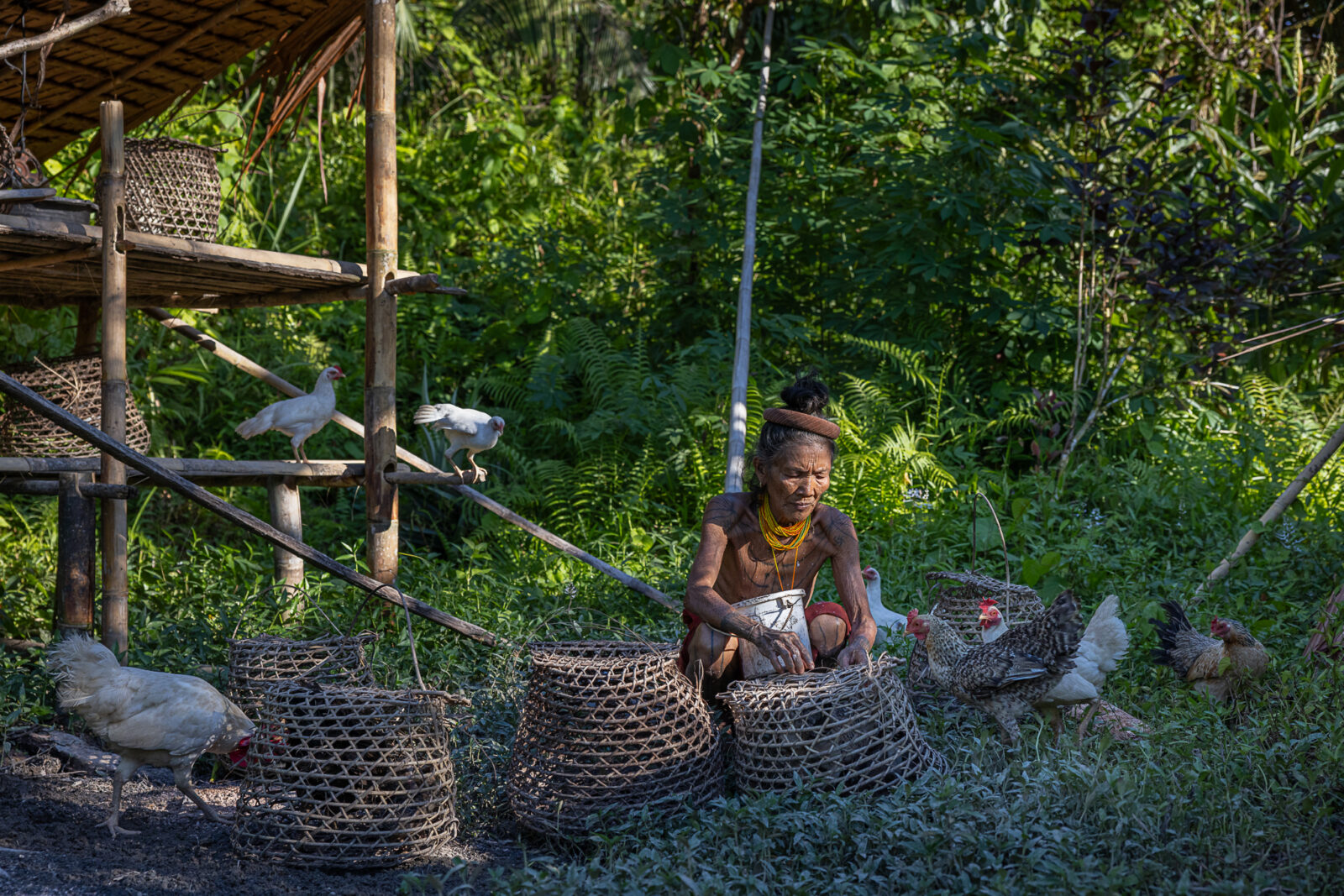
Chickens are essential in ritual life. They are used as spiritual mediators, gaut, in blessings and healing. Shamans gently stroke a chicken along a person’s body to draw out illness, then sacrifice it so its soul may carry the petition to the spirit world. The shaman reads the thin membrane covering the intestines to interpret the message received.
Their feathers adorn ritual headdresses, and even serve practical purposes, such as for cleaning ears.
During major ceremonies, dozens of chickens may be sacrificed, each contributing to the dialogue between humans and spirits.
Dogs
Hunters and Companions
Dogs, likely introduced long ago through early traders, are the only animals on Siberut given personal names.
Life for dogs inside the uma can be difficult. They are not fed and must scavenge for their own food. Because they often try to steal scraps, they are frequently beaten, and inside the house they move quietly and avoid drawing attention — rarely barking.
Yet outside, during the hunt, dogs reveal their true nature. Many uma keep one or more trained hunting dogs, and good hunters are highly valued. These dogs may receive extra food, care, and even accompany their owner on long journeys.
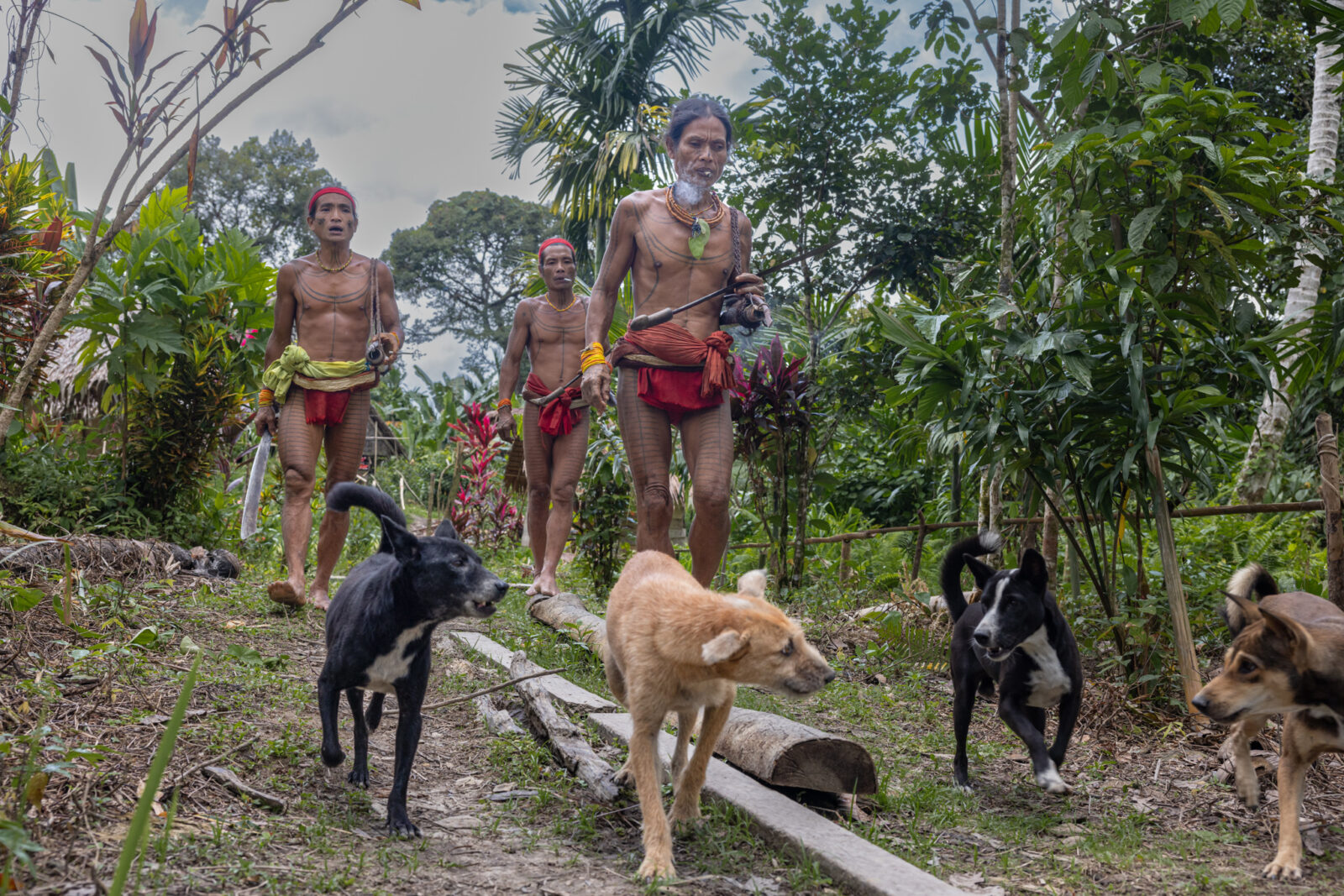
Dogs are essential partners in the forest, helping track pigs, deer, and monkeys, and their skills directly affect the success of the hunt.
Cats
Keepers of the House
Cats, also introduced historically, are kept primarily to control rats. They live freely around the uma and are rarely fed but are generally treated with more tolerance than dogs.
Stealing food is usually forgiven, and cats enjoy a quiet, accepted place in domestic life.
Animals and the Spiritual Web
Whether raised for food, used in ritual, or kept as companions, animals occupy an important place in the Mentawai worldview.
Each animal is understood to possess a soul and to radiate bajou, a vital force; both are seen as interacting with the human and spirit realms.
Raising, caring for, and sacrificing animals therefore involve maintaining respectful relationships, which are considered essential for harmony between the visible and invisible worlds.
Livestock and pets are integrated into a broader subsistence system based on gardening, sago production, fishing, hunting, and forest gathering. Together, they provide nourishment, companionship, ritual value, and continuity, shaping everyday life and the balance between people, animals, and spirits.
Hunting
Silence and Precision — a Dialogue with the Forest
Hunting and fishing shape daily life in Mentawai communities and embody deep relationships with the forest and river systems. These practices combine skill, patience, spiritual etiquette, and ecological understanding passed down through generations.
Beyond providing food, they affirm harmony between humans, animals, and the unseen world.
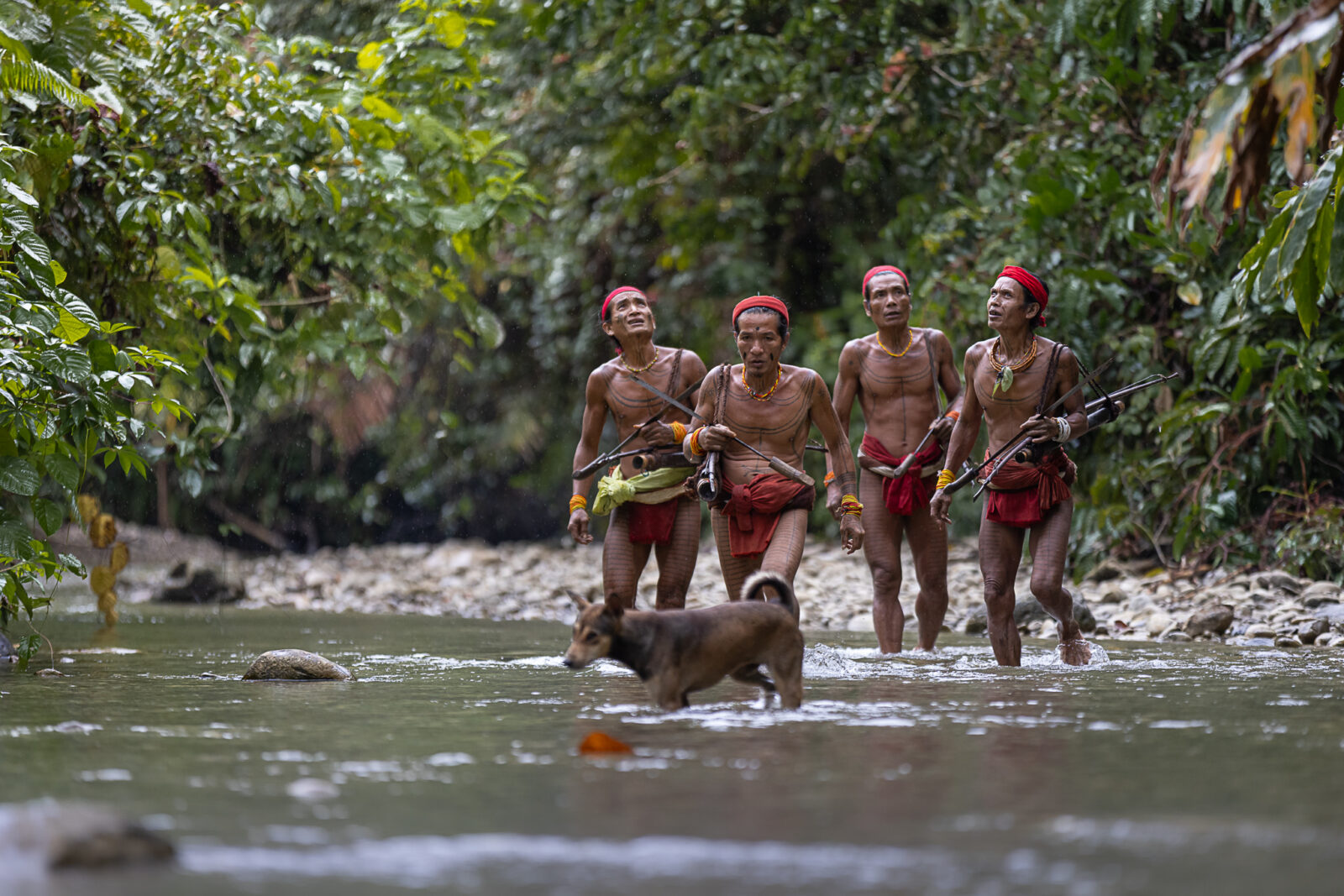
Hunting is always done with respect. Animals are believed to possess simagere, their own souls, and every kill is met with spoken thanks and small gestures of acknowledgment.
Larger ceremonies often conclude with a communal hunt. The rituals are not considered complete until game has been successfully taken, a sign that the forest spirits have acknowledged and approved the event, and that harmony between the forest, its human inhabitants, and the spirit world has been maintained.
UROUROU: Hunting with BOW & ARROWS
For the Mentawai, the rourou — the traditional bow — remains the central tool of the hunt. Crafted from the hardwood of a palm tree and polished with stone and leaves, it is strung with twisted bark strips from the baiko tree — the same bark used to make the kabit loincloth worn by the kerei. The bark cord is glued and strengthened with natural sticky latex from a tree known as onam.
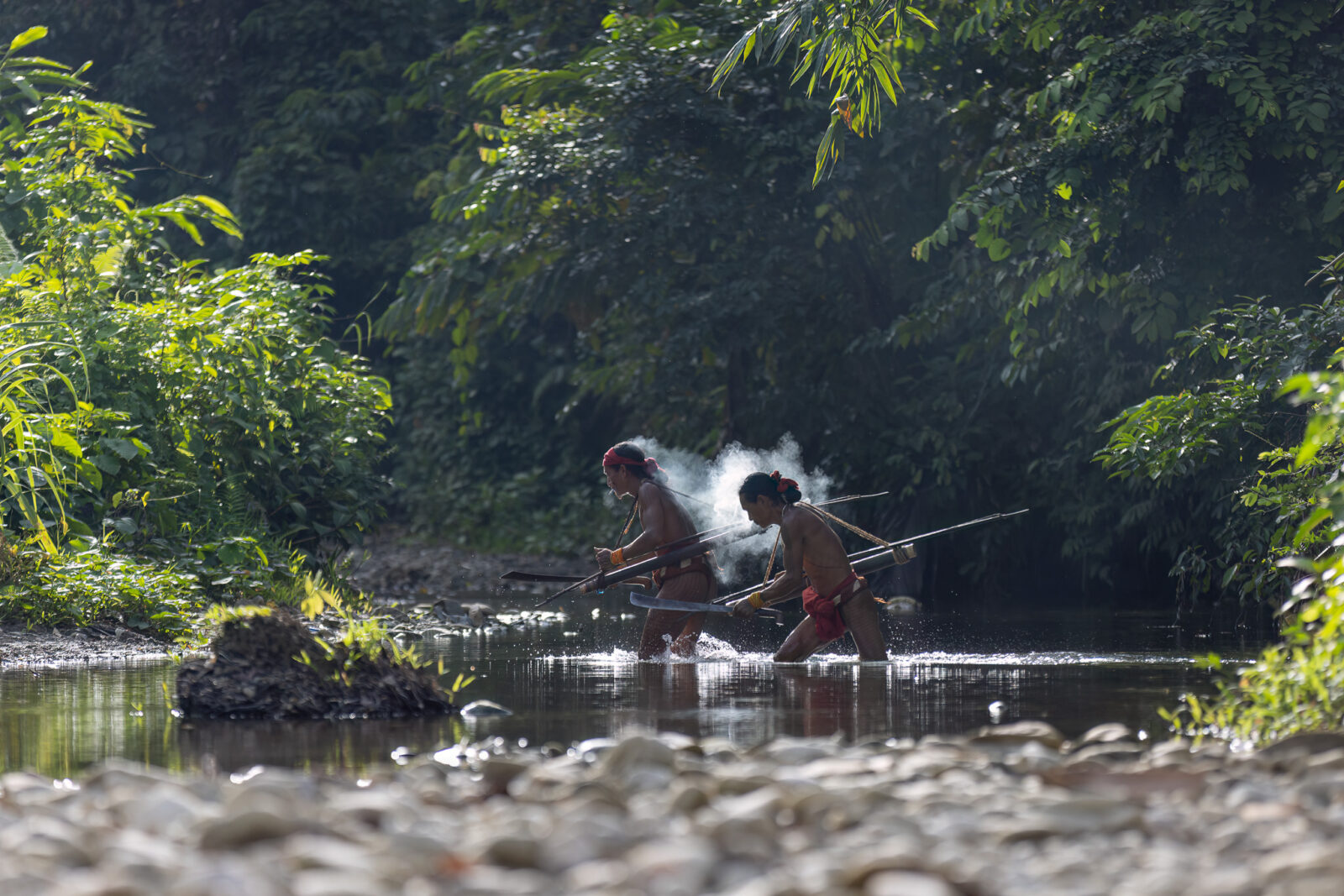
Arrow shafts, known as silogui, are made from a type of tall elephant grass found along the edges of the forest. Arrowheads are crafted in different forms depending on the animal being hunted. For monkeys, wooden tips are carved halfway so that they snap if the animal attempts to pull the arrow out, allowing the poison to act. Squirrels are hunted with un-carved, non-poisoned tips; the weight of the arrow gradually exhausts the animal until it falls from the tree. For larger game such as wild boar and deer, brass tips are used to penetrate thick skin. Birds are taken with thick, blunt tips, which avoid piercing the body or damaging feathers that are later used for ritual adornment.
Arrows are stored in the bugbug — a long bamboo container covered with a protective sheath from a sago-palm leaf. A thick rope of coconut-fibre allows the hunter to carry it together with the bow through dense forest.
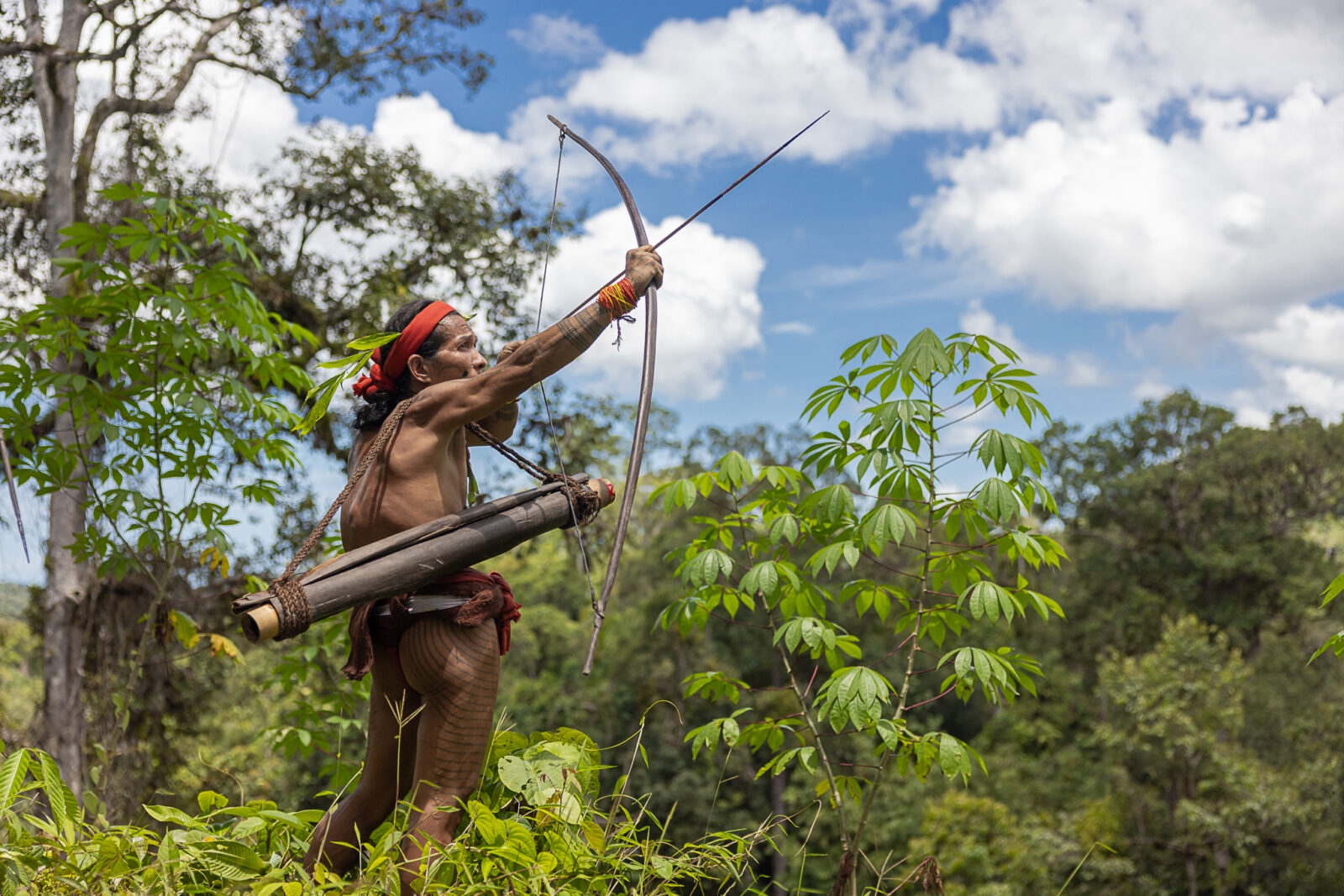
Of the four primate species found on the islands, only the bilou — a small gibbon — is taboo, likely because of its human-like qualities.
Ugab: Hunting with spears
Experienced hunters also use spears. Often hunting alone, they move through the forest in silence, reading signs in rustling leaves, muddy soil, and disturbed undergrowth. Well-trained dogs accompany them, helping to track and corner wild boar and deer.
announcing success — The Tuddukat
After a successful hunt, the tuddukat is played — each animal has its own distinct rhythm: different beats announce whether hunters have brought home a bokkoi monkey, a joja or simakobu langur, a deer, or a wild boar.
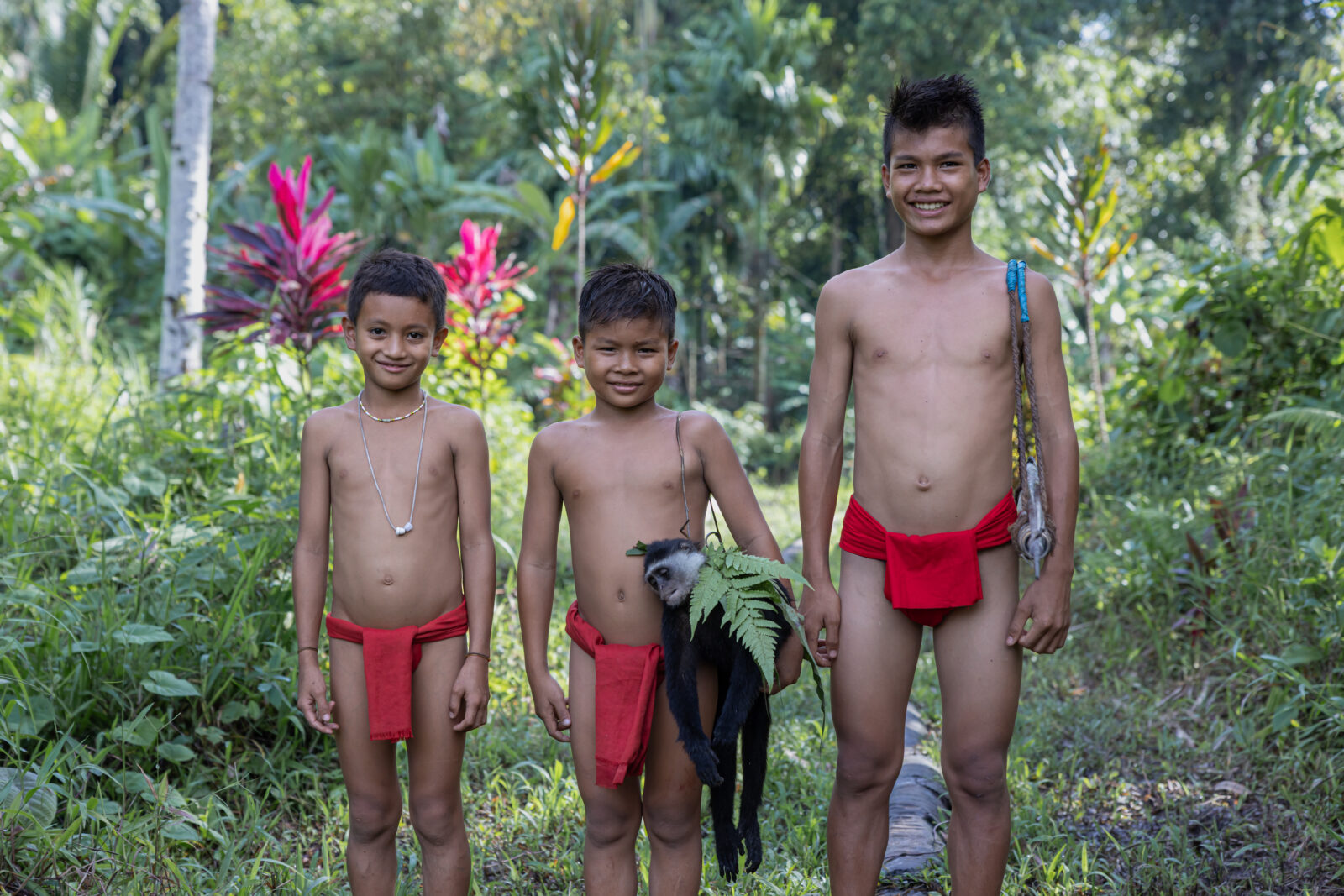
These rhythms carry precise meaning. Subtle extensions reveal whether the animal was male or female, young or adult, allowing everyone who hears the tuddukat to understand exactly what the forest has given.
The sound rolls through the valley, informing relatives and allied clans that meat will be shared. Game is divided and distributed across the extended clan — not only to those living nearby, but also to distant relatives, with young boys often sent out carrying portions through the valleys.
The tuddukat announces success, expresses gratitude to the animals, and honors the spirit-filled forest that continues to sustain Mentawai life.
Arrow Poison
The Hunter’s Knowledge and the Forest’s Power
Poison, or ragi, is essential for hunting larger game. Preparing it is a time-honored skill known only to experienced hunters.
The most common poison comes from the leaves of the ipuh bush. The leaves are cut with a machete, then grated across the spiny stem of a palm leaf. On a wooden plate, the grated leaves are crushed together with tuba root and chili. The chili stimulates blood flow in the animal and speeds the poison’s effect.
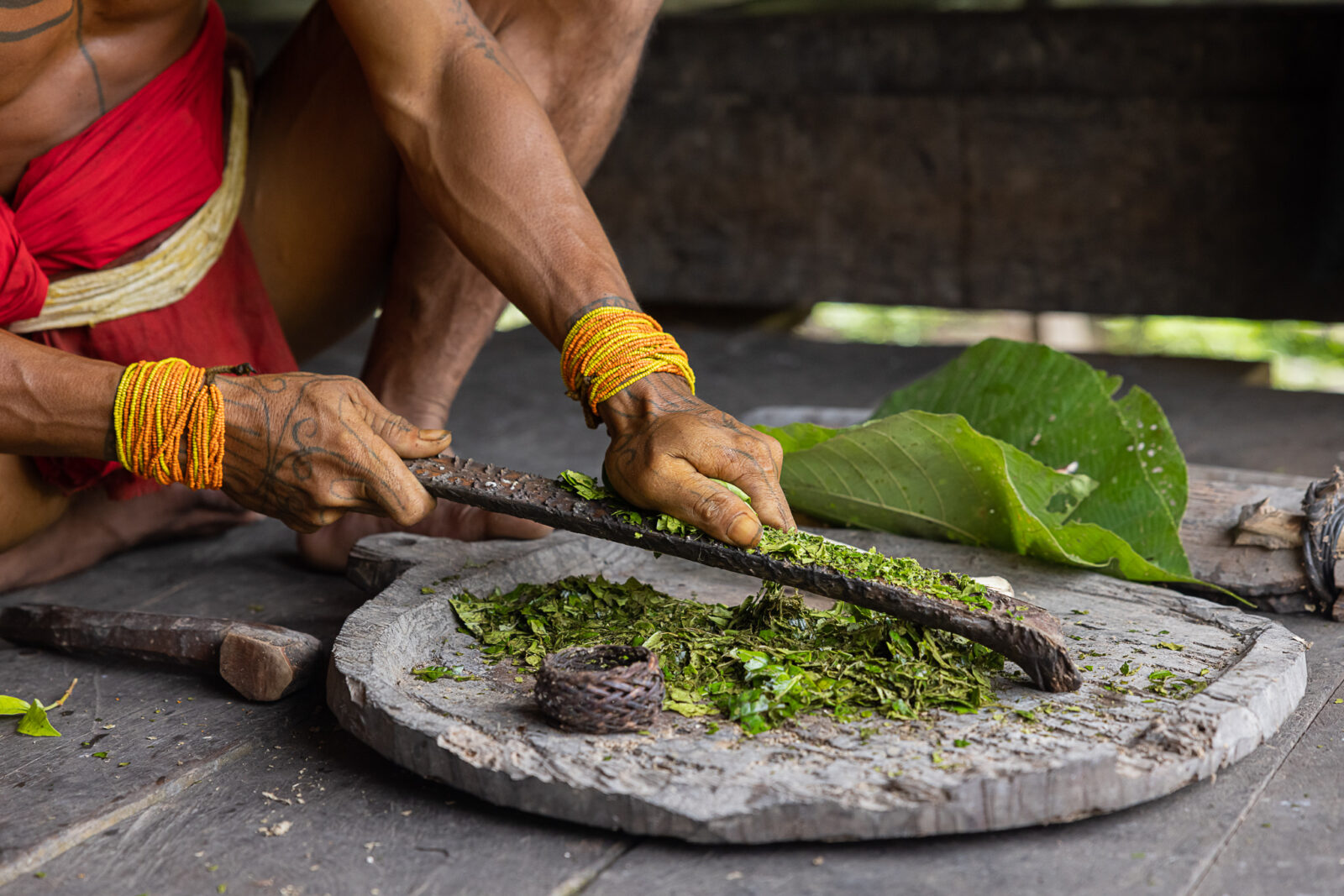
Another poison variety is made from the bark of a forest liana, ground and prepared in the same way with tuba root and chili.
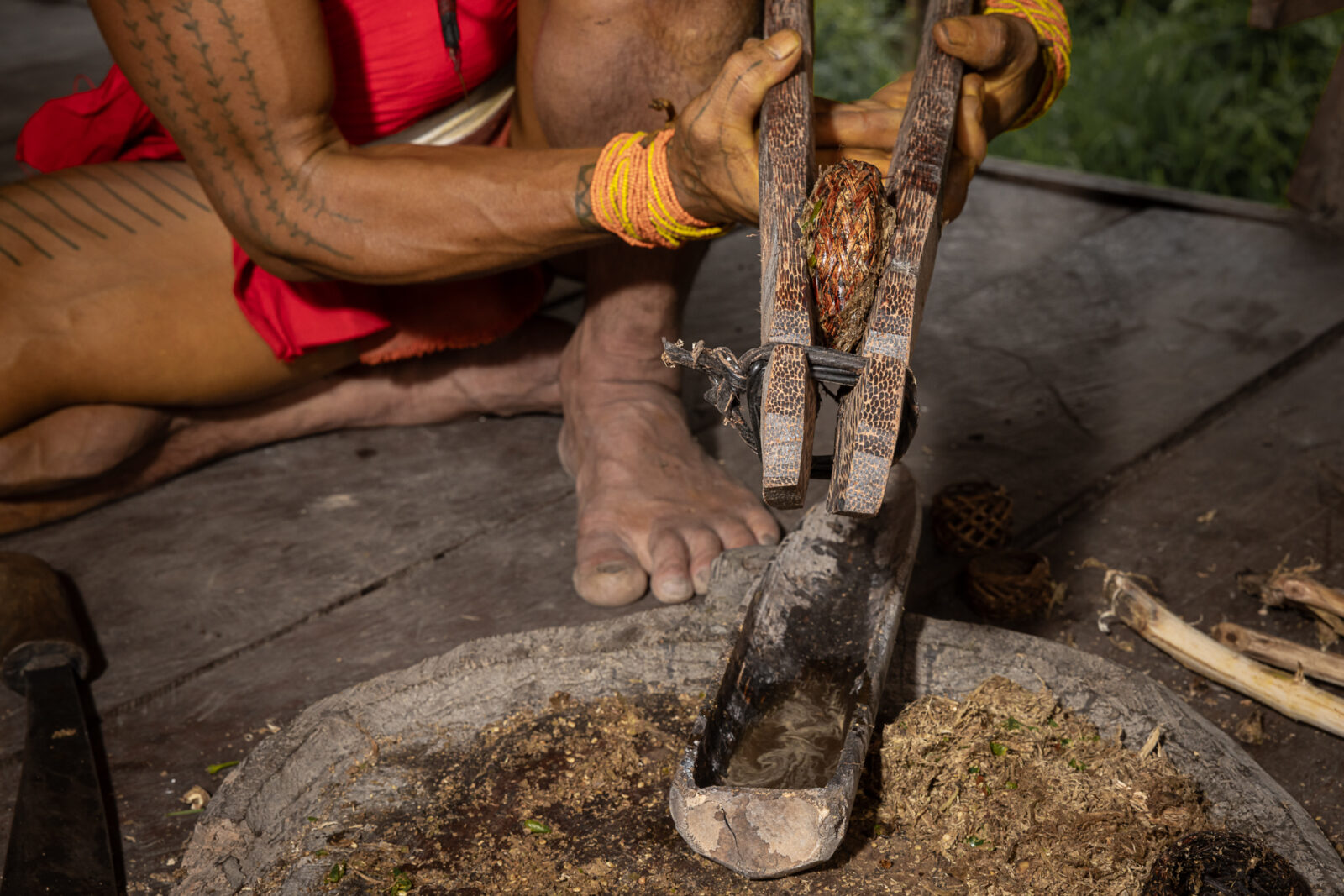
The ingredients are packed into a small rattan basket and pressed between large palm-wood squeezers, slowly forcing out the sap. The liquid is caught in a coconut shell or a length of bamboo, then heated until it gradually thickens.
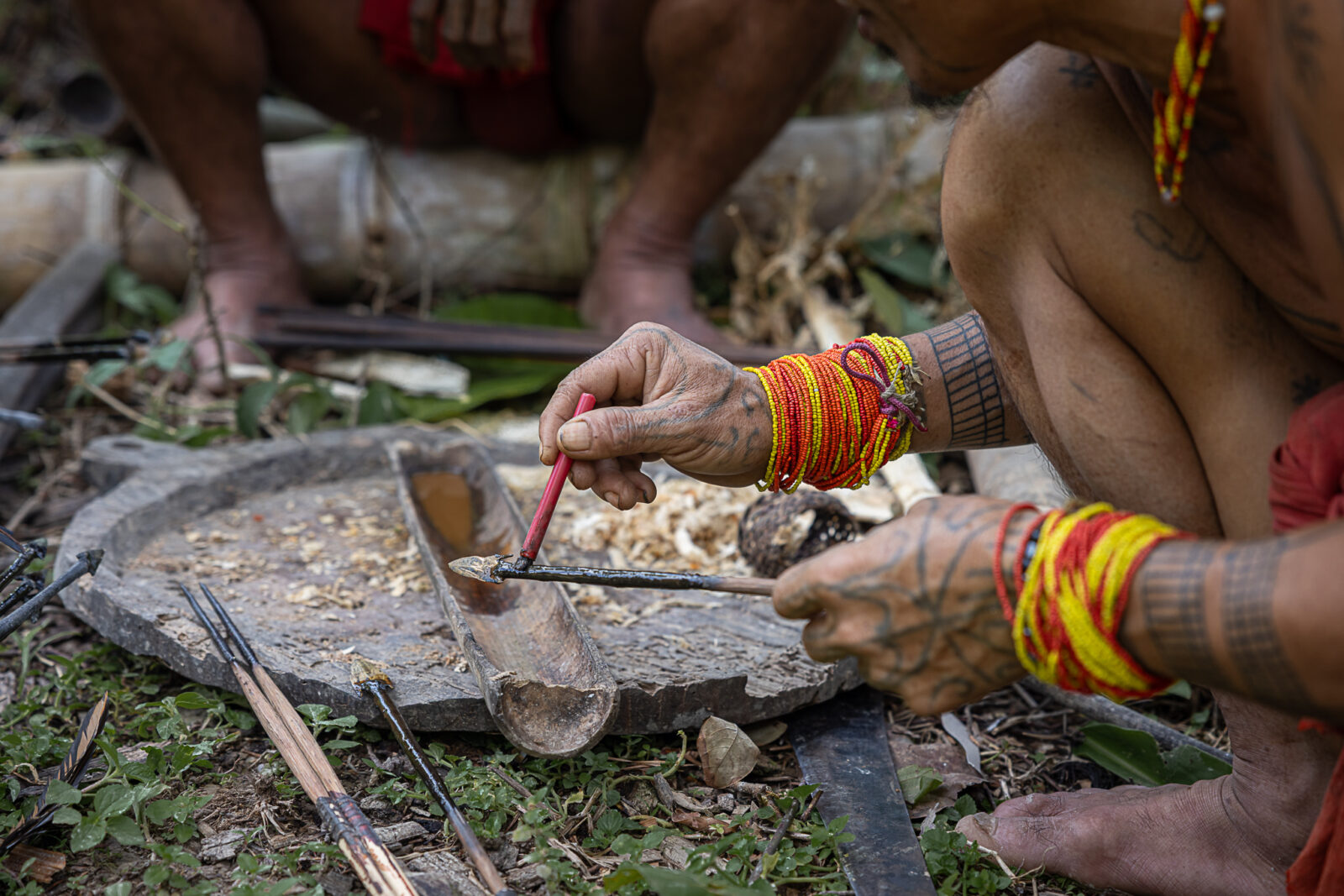
Using a small brush made from an animal tail or feathers, hunters apply the poison to the arrowheads in several thin layers, drying each layer slowly over a fire. Old arrows are re-treated as poison weakens over time.
Importantly, the poison is never prepared inside the uma. The skulls of previously caught animals hang in the house to honored souls; preparing poison in their presence could alert them and cause the hunt to fail.
The poison works quickly, paralyzing the nervous system or muscles and bringing down the animal swiftly and humanely. More than a hunting tool, it reflects a profound knowledge of forest plants and a careful ethical relationship with the beings who sustain human life.
Fishing — Paligagra and Pangisou
Women’s Skill and the Rhythm of Rivers
Fishing is traditionally the domain of Mentawai women, practiced both during the day and after nightfall.
Paligagra — daytime fishing
Women work in groups along rivers and mangrove inlets using handmade nets, fishing for small fish, shrimp and frogs. In deeper or wider river sections, they wear skirts made from fresh banana leaves; spread across the water’s surface, these disguise movement and prevent fish from scattering.
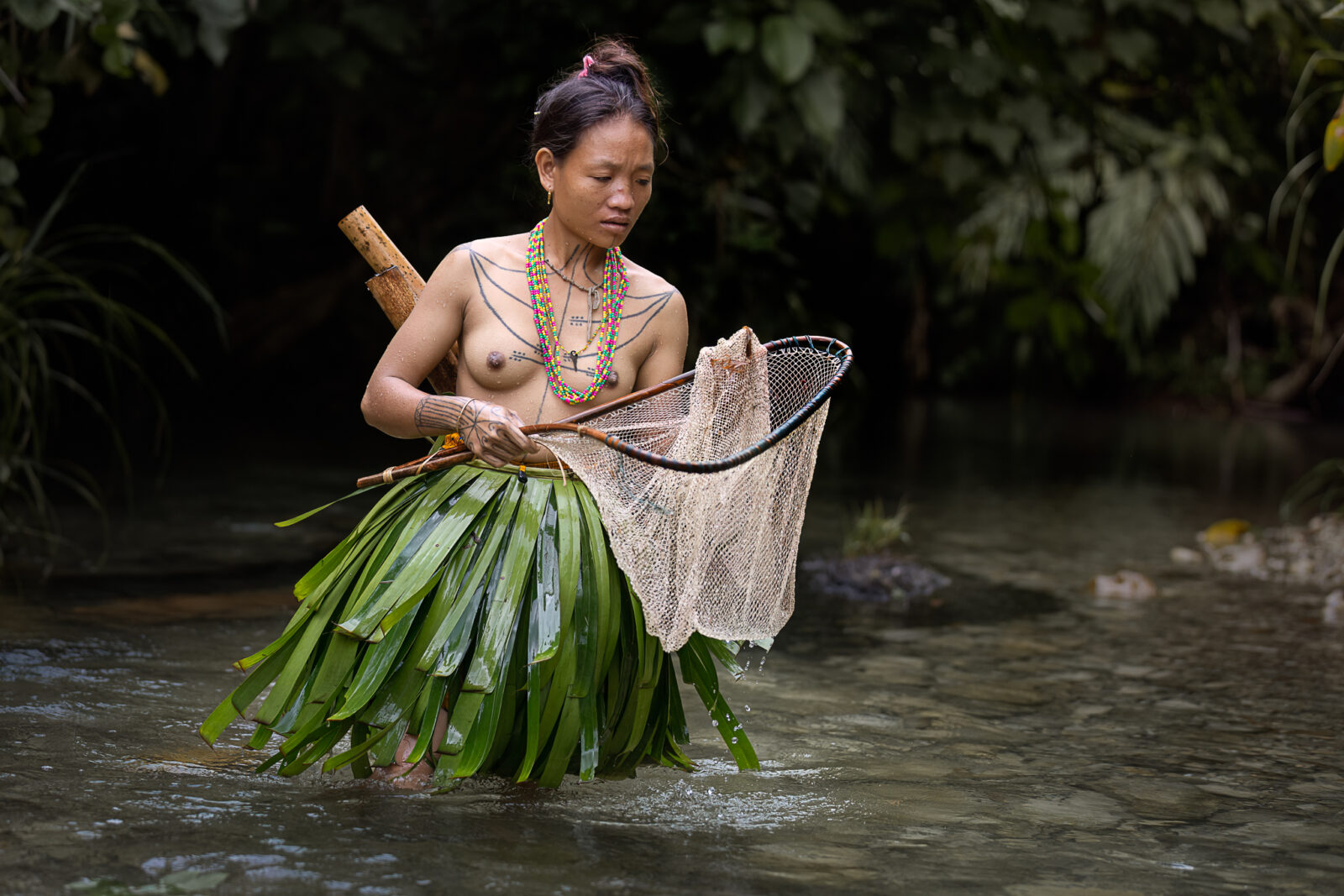
Pangisou — fishing at night
At night women wade through the shallow rivers and creeks carrying fire torches — kisou. The warm glow attracts fish and shrimp while illuminating the dark water.
Shrimp are easily spotted as the torchlight reflects in their eyes, and fish are guided into nets using subtle movements of the feet.
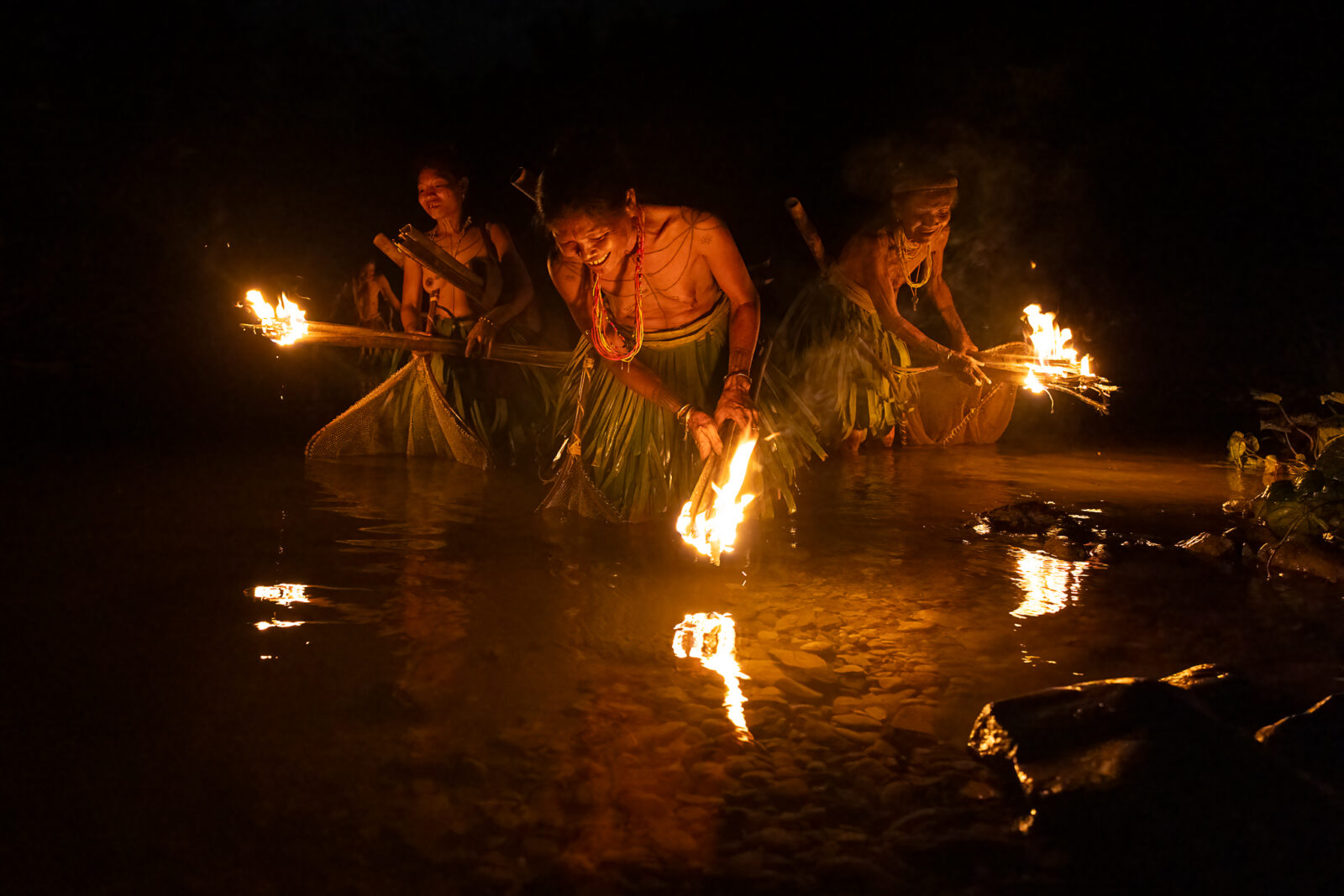
These river harvests — collected in small but steady amounts — are an important complement to sago and garden crops. Fishing is also a social activity, a time for quiet cooperation and shared skills passed from mother to daughter.
Forest FoodS
Tamara — Sago Grubs
Sago palms offer more than starch. When the trunk of a felled or processed palm is left to decay, sago beetles lay their eggs inside the softening pith. Within a few weeks, large white grubs — tamara — develop, feeding on the fermented sago.
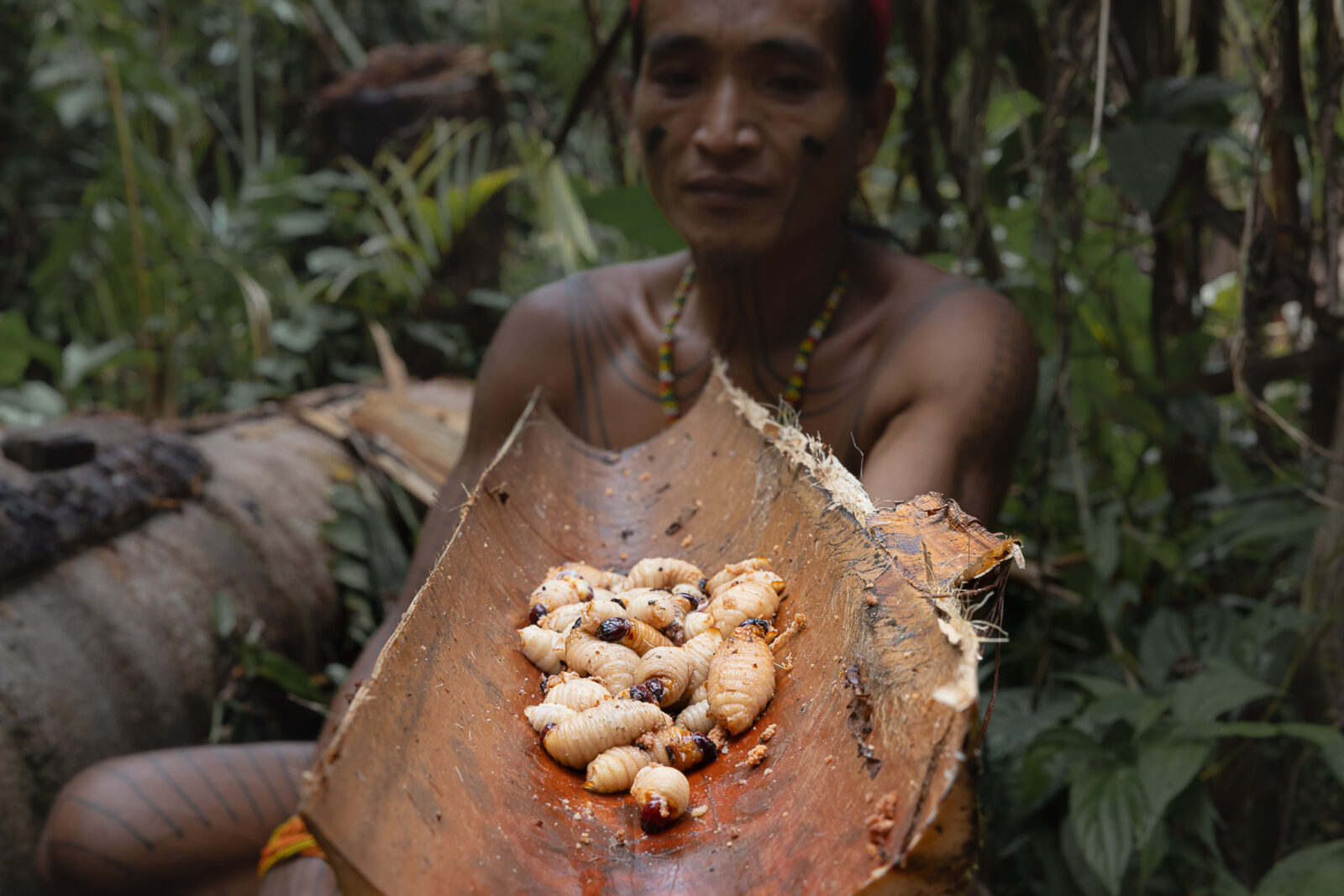
Men and children return to split open the trunk and collect the larvae by hand. Rich in fat and protein, tamara are roasted on skewers, boiled, fried, or eaten raw. Their oily sweetness is especially beloved by children.
These grubs are an important seasonal food, providing high-energy nourishment in a diet anchored by carbohydrates from sago and taro.
Hunting, Fishing & Forest FoodS
A Complementary System
Together, hunting, fishing, and gathering tamara form a flexible and adaptive subsistence system. Hunts bring meat for ceremonies and reinforce social cooperation. Fishing provides steady, reliable protein. Forest grubs and other wild foods add richness, seasonal variation, and nutritional diversity.
These practices express the Mentawai ethic of reciprocity: taking from the forest with respect, acknowledging the souls of animals, and maintaining balance between the human world and the living landscape.
Instruments
Echoes from the Forest — Music for Spirits and Kin
Music is woven into Mentawai life, from moments of leisure to the most sacred rituals. The most important instruments are the kajeuma — a set of three different sized drums carved from hollowed palm trunks and traditionally covered with python or monkey skin.
During ceremonies, the rhythmic pulse of the kajeuma accompanies the dances of the kerei. The central floor of the uma is built as an instrument itself: a resonant platform, amplifying each stamp of the shaman’s feet until the entire house vibrates like a drum. Sound becomes a bridge to the spirit world, guiding the movements of ritual.
Old brass gongs, acquired from Sumatran traders, also hold ceremonial significance. Their sharp, ringing tones announce the opening of rituals, summon participants, and punctuate moments of spiritual intensity.
Beyond the ceremonial sphere, lighter instruments are part of everyday life. Girls and young women often play simple bamboo flutes (pipiau) or mouth harps (jajaok), producing soft, clear tones that carry through the uma and nearby gardens.
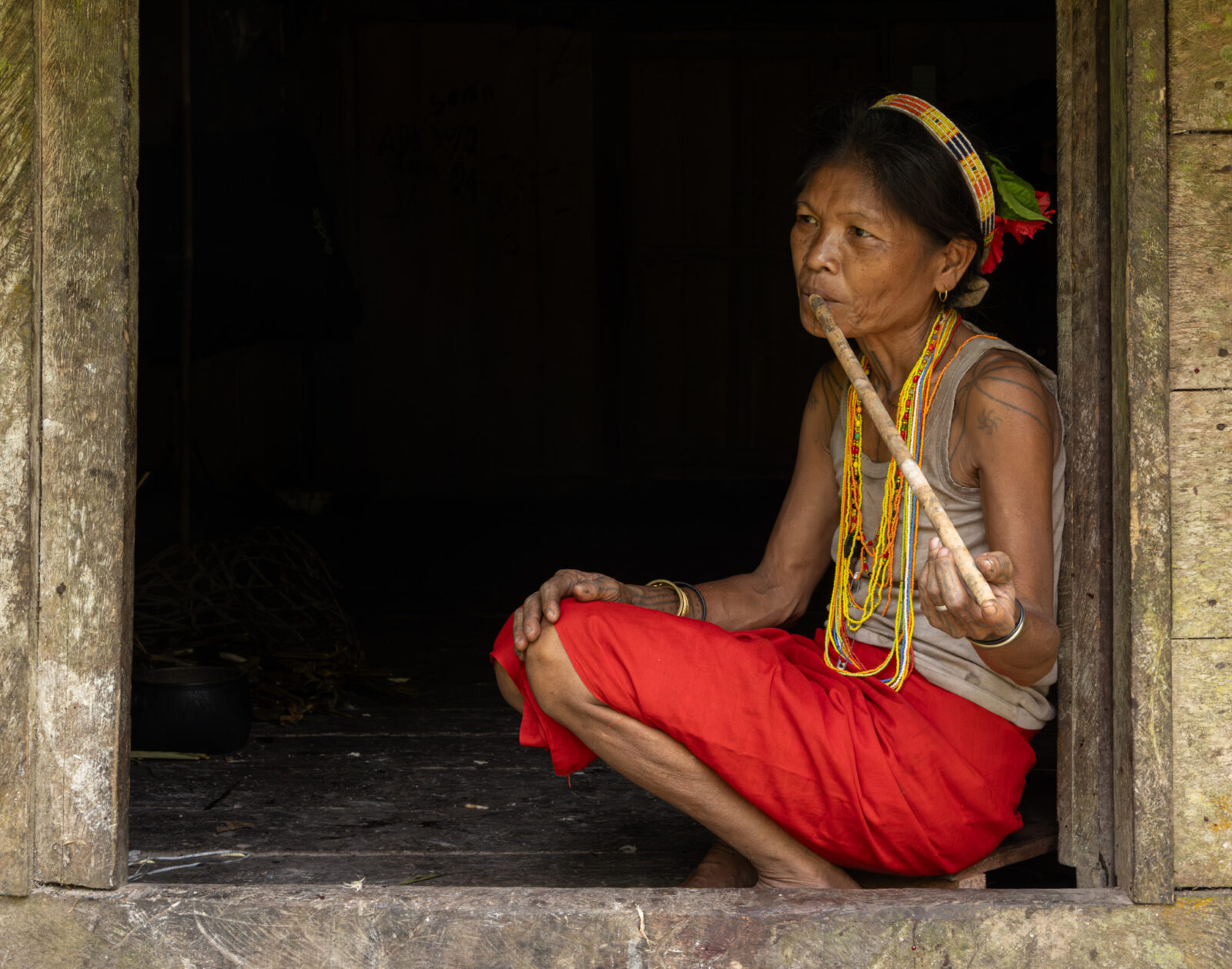
The pipiau is a simple bamboo tube without finger holes; different tones are produced by varying the placement of the index finger at the open end of the flute. Mouth harps were traditionally made from thin strips of bamboo, but today they have largely been replaced by brass models. These instruments are played during work, rest, or moments of social interaction, adding rhythm to daily activities and reinforcing a sense of ease and connection within the household.
Separate from these everyday instruments, a more complex and thicker bamboo flute with four finger holes, known as alei pusou, is reserved exclusively for mourning. It is played during periods of grief following the death of a member of the uma, accompanying weeping mourners and giving voice to loss rather than everyday life.
Together, these instruments — sacred and everyday — reflect a culture where sound is both expression and communication, linking people to each other, to the forest, and to the unseen world.